

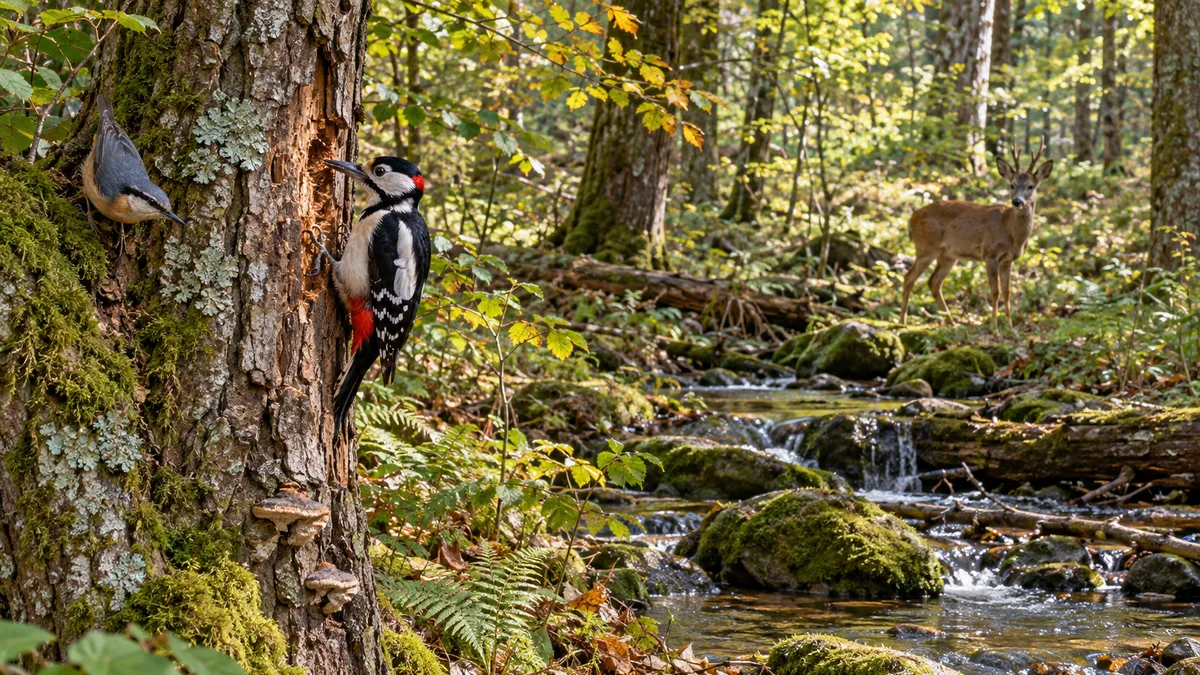
A habitat is where an organism lives, and an ecological niche is how it lives in that place. : what it eats, when it's active, what conditions it tolerates, and with whom it interacts. In ecology, a habitat is called a species' "address," and a niche is its "profession." The same habitat can be shared by many species, while a niche is a characteristic of a specific species.
To sum it up
- Habitat answers the question "where does it live?" - it is a physical place with specific conditions (forest, lake, meadow).
- Ecological niche answers the question "how does he live?" - this is the range of needs of the species and its role in the ecosystem.
- Many species can live in the same environment , but two species cannot permanently occupy the same ecological niche (Gause principle).
- The habitat is described primarily by physical factors, while the ecological niche is also described by food, activity, and relationships with other organisms.
Ecological niche – what is it?
Ecological niche encompasses all the vital needs of a species and its role in the ecosystem. It includes, among other things, the range of temperatures and humidity it can tolerate, the type of food and how it is obtained, its activity time, its breeding grounds, and its relationships with other species: competitors, predators, parasites, and symbiotic partners.
The concept of the ecological niche developed gradually. Joseph Grinnell emphasized the environmental conditions and adaptations that enable a species to survive. Charles Elton, in 1927, described the niche as an animal's position in the biotic environment, that is, its relationship with food and enemies—hence the comparison to a "profession." G. Evelyn Hutchinson, in 1957, conceptualized the niche as multidimensional space , in which each dimension represents a separate environmental factor (e.g., temperature, prey size), and the niche is the range of values within which a species can exist.
Basic niche and realized niche
Hutchinson also introduced the division into fundamental (potential) и realized niches . A fundamental niche encompasses all the conditions under which a species can survive without competition or enemies. A realized niche is the portion of the niche a species actually occupies in nature when sharing resources with other organisms.
Ecological habitat - definition and examples.
Habitat — is the habitat of an organism or population, characterized by a set of environmental conditions: soil type, humidity, temperature, sunlight, and the presence of water. Thus , An ecological habitat is primarily described by abiotic (non-living) factors and the structure of the environment, such as the presence of trees or aquatic vegetation.
Examples of habitats include deciduous forests, peat bogs, mountain meadows, coral reefs, lakeshores, or sandy seabeds. In Polish conservation practice, the concept natural habitat — as areas with certain types of vegetation and conditions, protected, in particular, by the Natura 2000 network. All these meanings have one thing in common: the habitat indicates, Where the organism lives.
Ecological niche and habitat are the most important differences.
Ecological niche and habitat are interdependent but not identical concepts. A habitat has a broader spatial range and can accommodate dozens of species. An ecological niche is "narrower" in the sense that it pertains to a single species and describes its relationship with all environmental factors, including biotic ones.
| Characteristic | Habitat | Ecological niche |
|---|---|---|
| Definition | The place where the organism lives. | Species needs and their role in the ecosystem |
| Question | Where does he live? | How does he live, what does he do? |
| Analogy | Address | Profession and lifestyle |
| Descriptive factors | Mainly physical factors: substrate, humidity, temperature, lighting. | Physical and biotic factors: food, activity, competition, predation. |
| Sharing | Many species can live in the same environment. | Two species cannot permanently occupy the same ecological niche. |
| What does this refer to? | Fragment of space | A specific species (population) |
| Example | Deciduous forest, pond, meadow | A bird that collects insects from tree bark, active during the day. |
Gause's principle, or why species are divided into niches
In the 1930s, Russian biologist Georgy Gause cultivated two species of paramecia in test tubes, each feeding on the same bacteria. Over time, Paramecium aurelia displaced Paramecium caudatum . Based on these experiments, a principle of competitive exclusion : two species using the same limited resources in the same way cannot coexist for long.
In nature, species with similar needs avoid this conflict, diversifying their niches They forage in different parts of the habitat, at different times, or using different food sources. A classic example, described by Robert MacArthur, is that several species of warblers forage for insects in the same spruce trees, but each species primarily forages in different parts of the canopy.
Examples: same habitat, different ecological niches.
Deciduous forest. The great spotted woodpecker and the nuthatch share the same habitat, foraging on tree trunks. The woodpecker climbs the trunk using its stiff tail to dig food out from under the bark. The nuthatch can climb down the trunk head-down, allowing it to peer into bark crevices from a different angle. They share the same habitat, but their ecological niches are not identical.
Meadow and pond. In one meadow, bees collect nectar and pollen, earthworms process organic matter in the soil, and a buzzard hunts rodents. In a pond, frogs hunt insects, and snails clean the water of algae. The habitat is typical, but the animals' roles are completely different.
How can we determine whether we are talking about an ecological niche or a habitat?
In a biology class or a final exam, a simple test is enough:
- If the description states place (for example, "lives in damp alder forests"), then this refers to the habitat.
- If the description mentions food, time of activity, range of acceptable loads, or family ties (e.g. "a nocturnal predator that hunts moths"), then it is a niche.
- If there is competition between two species for the same resource, then we are talking about overlapping ecological niches.
- It should be remembered that the ecological niche also includes the conditions of the habitat - this is a broader concept in terms of content, although it is applicable to one species.
Frequently Asked Questions (FAQ)
What is the difference between an ecological niche and a habitat?
A habitat is where an organism lives, such as a forest, lake, or meadow. An ecological niche is the range of a species' needs and its role in the ecosystem: what it feeds on, when it's active, what conditions it tolerates, and what competition it faces. A habitat is its "address," a niche is its "job.".
What is an ecological niche in simple terms?
This is a species' lifestyle: what it eats, how it obtains food, when it is active, what conditions it finds suitable, and how it interacts with other organisms. An ecological niche describes a species' place in the ecosystem's network of relationships.
What is the difference between a basic niche and a realized niche?
A fundamental niche is the full range of conditions in which a species could live without competitors or enemies. A realized niche is the portion of the niche a species actually occupies in nature when it must share resources with other organisms.
What does Gause's principle say?
The principle of competitive exclusion states that two species that utilize the same limited resources in the same way cannot coexist sustainably. One displaces the other, or the species differentiate their ecological niches.
Can two species live in the same environment?
Yes, many species typically inhabit the same environment. They coexist because they occupy different ecological niches—they consume different foods, forage for food in different places, or at different times.
See also
- What is the difference between reptiles and amphibians?
- What is the difference between a nature reserve and a national park?
- What is the difference between a viper and a snake?
- What is the difference between a coniferous forest and a forest?