

Non-Newtonian fluid — is a term that often arouses curiosity among both scientists and ordinary people interested in the unusual properties of substances.
Description: Learn about non-Newtonian fluids and their characteristics. Useful information for science and everyday life.
These fluids differ from familiar Newtonian fluids such as water or oil and attract attention due to their variable viscosity, which depends on external factors. In the modern world, such substances find application in industry, science, and even entertainment, making their study relevant. In this article, we will examine what a non-Newtonian fluid is, its characteristics, examples from everyday life, and how it differs from classical fluids.
Understanding the nature of non-Newtonian fluids helps explain many natural and man-made phenomena, from the behavior of quicksand to the properties of cosmetics. They play a vital role in rheology—the science of deformation and flow of materials, which has been developing since the 17th century, when Isaac Newton laid the foundations for the study of viscosity. Today, as of June 2025, these fluids are actively being studied to create innovative materials, and we will examine their properties, classification, and practical applications, drawing on proven data.
These substances are of interest not only to academics but also to enthusiasts conducting experiments at home. Their unique behavior—the ability to become solid upon impact and fluid at rest—makes them a popular subject for educational demonstrations and entertainment. We'll explore in detail how they work, the different types that exist, and why they defy Newton's classical laws to provide a comprehensive understanding of this topic.
Definition and differences from Newtonian fluids
A non-Newtonian fluid is a substance whose viscosity changes depending on the force or speed of action, unlike Newtonian fluids, where viscosity remains constant under all conditions. Newton discovered that for water or gasoline, the resistance to flow depends only on temperature and pressure, not on how fast the fluid is moving. Non-Newtonian fluids, by contrast, can thicken or flow at different shear rates—for example, a mixture of starch and water solidifies upon impact but melts under low pressure.
This behavior is explained by the complex structure of molecules, which interact differently under stress. Water, a typical example of a Newtonian fluid, flows uniformly regardless of the force of agitation, whereas non-Newtonian fluids, like ketchup, become more fluid when shaken. This property makes them unpredictable and interesting to study, especially in conditions that require adaptation to stress.
They differ from their Newtonian counterparts in the nonlinear dependence of viscous stress on the velocity gradient. Scientists note that such fluids do not obey the Navier-Stokes equation used for Newtonian fluids, requiring specialized models to analyze their flow, such as the Bingham or Herschel-Bulkley models.
Types of non-Newtonian fluids
Non-Newtonian fluids are classified based on how their viscosity changes with force or time. Pseudoplastic fluids, such as polymer solutions or yogurt, decrease in viscosity with increasing shear—this is noticeable when mayonnaise is squeezed out more easily when pressed quickly. Dilatant fluids, such as a cornstarch slurry, thicken with rapid movement, allowing a short-lived run across their surface.
Bingham fluids, such as toothpaste or paint, require a minimum threshold of force to initiate flow and remain solid until this point. Below this threshold, the paste does not flow from the brush. Thixotropic fluids, including some gels and drilling fluids, reduce their viscosity under prolonged load but return to their original consistency when left undisturbed, making them convenient for paint application.
Rheopectic fluids, rare in nature, increase in viscosity over time under load, a phenomenon found in some high-tech lubricants. Each category has specific characteristics dependent on their molecular structure and conditions, making their classification important for practical applications.
Examples and everyday use
Non-Newtonian fluids surround us in everyday life, often going unnoticed. Ketchup, which only disperses from a bottle when vigorously shaken, is a pseudoplastic liquid, making it easy to use in the kitchen. Toothpaste, which remains on the toothbrush until pressed, is a Bingham liquid, making it convenient for hygiene.
In industry, they find application in the production of bulletproof vests, where dilatant fluids, such as those based on polymers, harden upon bullet impact, distributing the energy. Cosmetics, such as shampoo, often contain thixotropic components that are easy to apply but thicken when applied to hair. These examples demonstrate how their properties can be tailored to human needs.
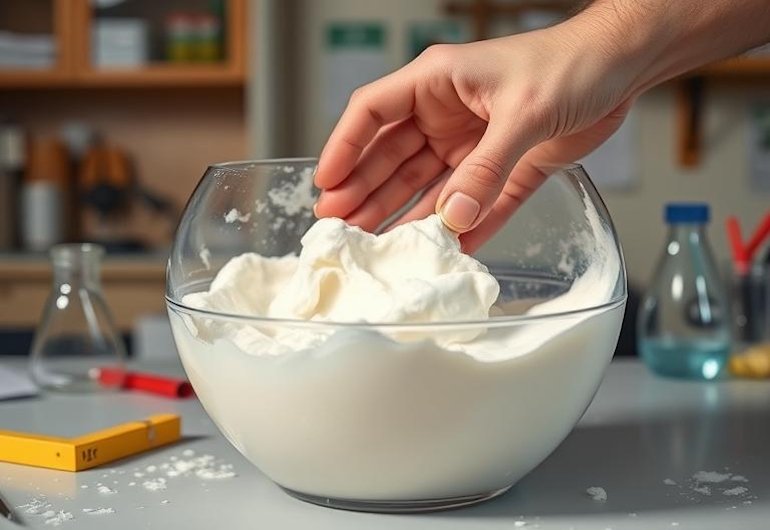
Experimenting with homemade starch solution is a popular way to explore dilatant behavior. When quickly struck, the mixture hardens, allowing you to walk on it, while under gentle pressure, it flows like a normal liquid, making these experiments fascinating for both children and scientists.
Impact on health and safety
Safety concerns about non-Newtonian fluids are often related to their use in everyday life and industry. For example, quicksand, a natural dilatant fluid, is dangerous if a person panics and moves quickly, which increases the viscosity and pulls them deeper. Slow movements help them escape by reducing resistance.
In the food industry, pseudoplastic liquids, such as sauces, are safe, but their excess use can pose health risks due to additives. Body armor containing polymer liquids reduces impact injuries by reducing deformation to 1 cm versus 4 cm for Kevlar, increasing protection.
Long-term exposure to chemical components, such as those used in gel production, requires precautions, although no direct harm to the skin has been identified. This underscores the need to study their composition for safe use.
Conclusion
A non-Newtonian fluid is a unique phenomenon characterized by variable viscosity under the influence of force or velocity, unlike stable Newtonian fluids such as water. Their types—pseudoplastic, dilatant, Bingham, thixotropic, and rheopectic—find application in cooking, cosmetics, industry, and even military applications. Examples such as ketchup and starch mixture demonstrate their unusual behavior, and the safety of use depends on the context. As of June 2025, these substances remain a subject of research, opening new opportunities for technology and education.