


Many insects look and act disgusting. Mosquitoes, for example. Few people like these blood-sucking bastards, who can drive you crazy with their squealing at night.
However, there are insects that are not just disgusting, but truly repulsive in their appearance and/or habits. These little guys the most terrible insects in the world. The list also included some particularly nasty insects, representatives of the arachnid class.
10. Domestic centipede
 A cross between two creepy insects—spiders and centipedes—house centipedes (also known as house centipedes and common flycatchers) actually feed on spiders, bedbugs, moths, cockroaches, ants, and other house guests we hate (humans are not included).

They grow up to 6 centimeters in length and are venomous. The venom (if the centipede goes berserk and attacks a human) feels similar to a bee sting. However, it is not life-threatening. Furthermore, if the centipede itself risks becoming prey, it can detach its trapped legs from its body.
9. Bedbug
 Most species of these tiny bloodsuckers feed on humans only when other prey is unavailable. Their bites are usually unnoticeable because they bite primarily at night while we sleep. Bed bugs especially favor the neck and jaw line.
Typically, the bug will spend about 20 minutes in physical contact with its host, and after a hearty meal will not attempt to feed again until it has completed the molting process or (if an adult) has completely digested the meal.
8. Ixodid tick
 One of the most vile and dangerous representatives of the arachnid class has adapted to survive even in the Arctic and Antarctic. Yes, Ixodid ticks even live on penguins.
There are 650 species of ixodid ticks. However, the most common ticks that bite people and animals are the dog tick (Ixodes ricinus) and the taiga tick (Ixodes persulcatus). Contrary to popular belief, ticks don't fall from trees onto unsuspecting travelers. They lie in wait for their victims on stems and blades of grass, attaching themselves to people or animals using their claws and suckers. When necessary, ticks can move quite quickly.
7. Giant Weta (Ueta)

These wingless, plump "cuties" aren't actually all that scary compared to the previous entries on the list of the most disgusting insects on Earth. But if you stumbled upon something equally enormous while out for a walk, I bet you'd scream. These members of the genus Deinacrida are found in New Zealand and can grow three times larger than a common mouse, making them among the largest insects in the world.
 In 2011, the largest officially recorded weta weighed 71 grams. For some reason, the discoverer decided to feed the insect a carrot. Quite cute and very, very strange.
6. Antlion larva
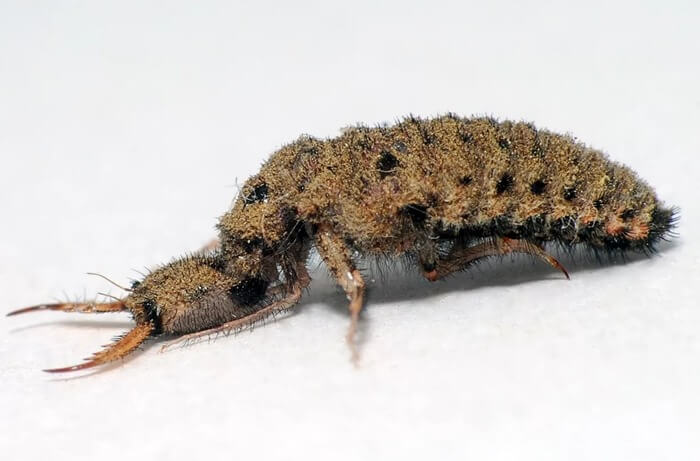 These insects get their name from the appearance and lifestyle of their larvae. They have a short, wide abdomen and powerful, sickle-shaped jaws with canals through which they suck out their prey.
These nasty-looking little creatures live in sand, in craters up to 5 centimeters deep and 8 centimeters in diameter. The host sits in the center of the crater, its jaws protruding, waiting for its prey. These are usually ants and various arthropods. If the prey manages to escape the crater, the antlion larva begins to hurl sand at it with sharp movements of its head. This sandy attack often knocks the prey off its feet and sends it falling back to the bottom of the crater. Afterwards, the antlion sucks it dry, and the larva simply discards its useless chitinous exoskeleton from its home.
5. Kissing bug
 Imagine someone with a needle in their face. They inject venom through the needle and then suck out the victim's liquefied entrails through the same needle. Now imagine that such a creature is real. And it's called the kissing bug, or triatomine bug.
 Some species of kissing bugs disguise themselves with the remains of dead insects, which creates very effective camouflage. These monstrous insects earned their name because they love to bite sleeping people in the soft tissues around the lips and eyes. Fortunately, you're unlikely to encounter them unless you're traveling through the American tropics, Mexico, or Central America.
4. Camel spider
 One of the largest spiders in the world is distinguished not only by its repulsive appearance but also by its incredibly powerful jaws, capable of biting through a human fingernail. In South Africa, camel spiders are called "barber spiders" due to the belief that they use their jaws to cut the hair of people and animals and then line their underground burrows with it. Would you make an appointment with such a barber? I certainly wouldn't.
3. Cockroach
 They hide in dark corners and creep through the darkness on all their hairy legs. Through our kitchen! Through the food!
They're fast, omnivorous (they'll even eat paper, leather, and gouache), and adapt perfectly to any environment. When threatened with being crushed by a slipper, a cockroach can run 22 cm—about 50 body lengths—per second. That's equivalent to a human running at 330 kilometers per hour. Perhaps in a nuclear apocalypse, where some go to heaven and others simply die, cockroaches will survive. A nasty prospect, right?
2. Japanese giant hornet
 These ferocious winged devils can grow up to 4 centimeters in length, with a wingspan of up to 6 centimeters. Their enormous 6-millimeter sting injects venom that is not only extremely painful but can also attack the nervous system.
 Giant hornets fly at speeds of up to 40 km per hour and over distances of up to 100 km, so don’t try to outrun these insects – you’ll lose.
 Japanese giant hornets are known for their aggression and fearlessness, especially toward European honeybees, which are often kept by Japanese farmers. If a hornet encounters a hive, it will mark it with pheromones, alerting other hornets in the area to its presence. Then the horrific carnage begins. The hornets dismember defenseless bees with their sharp mandibles. A single hornet can kill approximately 40 bees per minute!
1. Malaysian assassin bug
 There are many different species of so-called assassin bugs (within the family Reduviidae), some of which can transmit dangerous diseases to humans, such as Chagas disease.
 These insects earned their nickname because they attack quickly and mercilessly. They puncture their prey with their proboscis and inject it with an enzyme that softens the entrails so they can be sucked out like a delicious organic smoothie. One species found in Malaysia (Acanthaspis petax) even glues the corpses of its victims—mostly ants—to its back with sticky secretions. It wears these corpses like a kind of armor, and when threatened, it can shed them and flee unencumbered. It's unlikely anyone would want to mess with a vile insect festooned with the corpses of its enemies.