

Space travel is quickly becoming a potential solution to all the problems facing Earth, but how achievable is it, really? While recent advances in robotics, artificial intelligence, navigation, communications, rocket design, and other fields have allowed humanity to explore space further than ever before, we still need to solve many problems before we can finally leave Earth and settle among the stars.
10. Bone loss

Bone loss is one of the most debilitating consequences future astronauts will likely face on long-term space missions. Despite their hard, unchanging appearance, bones are actually quite flexible, constantly remodeling themselves based on the weight they bear. Because gravity exerts a constant force on the body, human bones on Earth become quite strong and robust.
However, in space or other microgravity conditions, bones begin to rapidly lose their strength. This isn't a problem for short-term missions, but for longer missions to Mars and beyond, it's a serious issue. let , which is unlikely to be resolved anytime soon. On average, astronauts lose about 1–2 % of bone mineral density each month. One study showed that during missions lasting six months or longer, they can experience bone loss equivalent to about two decades of aging. During a three-year mission to Mars, it could reach50% , making it impossible to return to Earth's gravity without serious health problems.
9. Navigation

Navigation is something most of us take for granted. It's now possible to pinpoint your location to within a few meters virtually anywhere on Earth thanks to a constant stream of satellite information from cutting-edge positioning systems like GPS in the US. и Galileo in the European Union. Even without them, other, older navigation methods, such as a magnetic compass, could still be used to navigate the world.
However, in space, things aren't so clear-cut. While many countries have their own deep-space satellite networks that support their space operations, they only operate over relatively short distances. Space navigators of the future must be able to calculate their position, current speed, and other flight parameters based on a constantly moving set of readings, since everything in space is constantly in movement .
NASA is currently working on a system called DPS , or deep space positioning system, to provide navigation within the solar system, which will be necessary if we ever hope to travel to Mars. However, beyond this, navigation remains one of the biggest unsolved challenges for future space travelers.
8. Cardiac atrophy

Cardiac atrophy is another serious, unresolved health issue that astronauts are likely to face during deep space missions. Simply put, the human heart becomes quite strong on Earth, as it must work against gravity to pump blood from different parts of the body. organs . However, in the microgravity conditions of space, this stress no longer exists. Research showed that the hearts of astronauts who spend long periods of time in space become more spherical than elongated, leading to a permanent loss of muscle mass.
To counter this, astronauts must exercise regularly to maintain muscle mass, although this only lasts for a few months. For multi-year missions to Mars and other planets, the loss could be permanent, posing a serious challenge to their well-being upon return to Earth's gravity.
7. Radiation

Cosmic radiation is one of the most limiting factors for deep space travel. Although some amount of radiation exists everywhere on Earth, even in in the air , The air we breathe is not as harmful as what flies around in space; from harmful gamma and x-ray radiation to neutron particles that can damage or even kill living cells.
Fortunately, the Earth's atmosphere and magnetic field protect us from most of this, although such protection no longer exists in space. We currently have no data on how long-term cosmic radiation affects the human body, as manned Missions are currently carried out only within low Earth orbits, where the Earth's magnetic field still exists. Although modern spacecraft and spacesuits are equipped with special means protection from radiation, we are not sure whether they will help in longer missions, such as the one planned to Mars.
6. Space debris
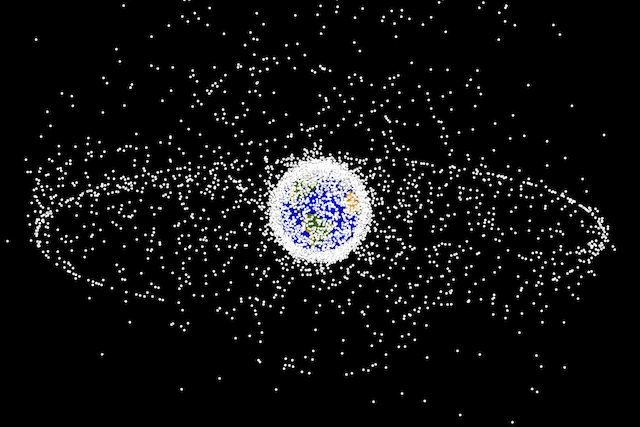
The US Department of Defense is currently tracking more than 27 000 potentially hazardous human-made debris floating in lower Earth orbit. If we include smaller pieces, this number could reach 500 000 , consisting mainly of debris from previous rocket launches and collisions with space rocks.
Space debris is quickly becoming a serious problem for future spaceflight. There are already so many rogue objects orbiting Earth that navigators must maneuver around them to avoid collisions. However, collisions still occur, such as when a Chinese satellite was severely damaged by debris from an old Russian rocket back in 2021, creating at least 37 new ones. debris . As we launch more and more rockets, probes, and satellites into space, the problem will only get worse and more difficult to solve.
5. A New Era of War

Although we have seen many wars around the world since World War II, it was a period of relative peace between major military powers. Nuclear deterrence has rendered, at least for now, the global industrial wars of the 20th century obsolete.
However, with the colonization and inevitable militarization of space, this deterrence will soon disappear. Although Outer Space Treaty The 1967 law banning any weaponization of space has not stopped a number of countries, including Russia, the United States, India, China, and others, from launching various types of military equipment into orbit.
A military conflict in space not only poses a threat to peace and stability on Earth, but could also potentially prevent anyone else from launching their own space missions. Imagine the amount of space garbage , left over from a full-scale battle between the major nuclear superpowers.
4. Outer limit

Popular space travel fantasies take for granted that we will one day unravel the mysteries of the scaling of the universe, allowing us to travel to other galaxies and star systems beyond the Milky Way and beyond. They assume that intergalactic travel is simply a matter of scientific progress and changing laws of nature, and that the universe is a static, unchanging place.
Unfortunately, there's a good chance we'll never be able to travel beyond a certain point in space. As the light from distant stars and other objects accelerates and moves away from us, observing them becomes increasingly difficult—even with our most powerful telescopes. If we were to travel at the speed of light right now, we'd still only be able to reach about 3% the currently observable universe—a sphere that is constantly shrinking over time. Given enough time, everything outside local group galaxies, which include the Milky Way, Andromeda, and Triangulum, as well as about 50 smaller galaxies, will become inaccessible.
3. Playback

Still no one has There's been sex in space, at least not one we know of. It's incredibly difficult—nearly impossible—to achieve in microgravity due to the mechanics involved. Studies of astronauts who spend longer periods in orbit also show a significant decrease in sex drive, making the repopulation of future space colonies even more challenging.
In addition, many of the biological processes underlying human reproduction require Earth's gravity and low levels of radiation to complete. Experiments on various animals have been unsuccessful , although some do report abnormalities, such as decreased sperm count and other sexual health issues. Moreover, our bodies function very differently than, say, rats. Until now, no studies have been conducted on the effects of microgravity and space radiation on a fully developed human embryo.
2. Gravity

It's now clear that gravity is inextricably linked to all life on Earth. From regulating basic life processes like reproduction to maintaining an atmosphere that protects us in many ways, it's almost a prerequisite for life as we know it. we know her , just like water or sunlight. Without it, it would be extremely difficult—if not impossible—to create long-term and sustainable colonies in space.
Unfortunately, we still don't have a way to replicate it beyond Earth—not without other serious side effects. While artificial gravity can be induced by motion, we have no way to maintain a stable, constant gravitational field. According to one theories , this could be done using antigravity or negatively charged gravitational particles, although such particles have not been found so far.
1. What about Earth?

The idea that we can leave Earth and all its problems behind in the next few decades is not only scientifically implausible, but also makes us dismissive of these problems. While problems like climate change, widespread food shortages, global hunger, political conflict, and others may seem too serious to tackle right now, they are relatively much easier to solve than the nearly impossible task make another planet habitable.
Moreover, there are several historical examples of people traveling to other inhospitable environments and living there, even right here on Earth. It would be much easier, say, to terraform Antarctica for human habitation than Mars, though this idea has never been realized, likely because a terraformed Antarctica would likely still be a terrible place to live. Earth provides a naturally favorable environment for life . to flourish is something that can never be reproduced in a foreign environment.