

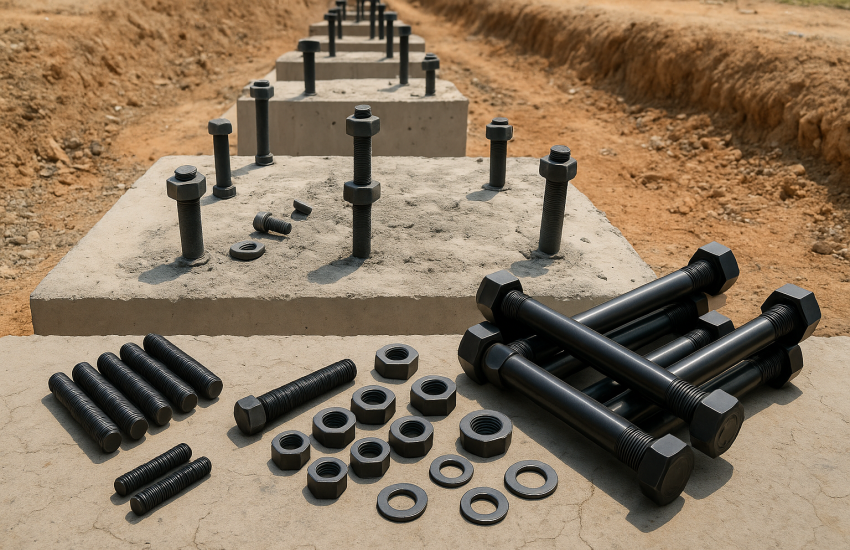
When we look at skyscrapers, bridges, or industrial complexes, few people think about what keeps these giants grounded. The answer lies not only in concrete and rebar, but also in subtle yet crucial elements: foundation bolts. These metal fasteners work in the shadows, but without them, no reliable structure is possible. Today, we'll talk about them not as dry technical details, but as true heroes of the engineering world. Here are 10 informative facts that will surprise even seasoned builders.
1. Foundation bolts are more than just «nails in concrete.»
At first glance, a foundation bolt may seem like just a long fastener embedded in concrete. But in reality, it's a complex engineering component designed to withstand a variety of factors: loads, vibration, temperature fluctuations, corrosion, and even seismic activity. Each bolt type is selected for a specific task—from installing a pump in a factory to securing columns in a high-rise building.
Engineers carefully calculate:
- length and diameter of the rod,
- the shape of the bend or anchor plate,
- steel grade and type of protective coating,
- the depth of embedment in concrete.
Calculation errors can lead to equipment displacement or even structural collapse—that's why foundation bolts are always designed in close consultation with architects and builders.
2. They come in all sorts of shapes - and not all are straight
There are several basic types of foundation bolts, each of which is the result of engineering evolution:
- Straight bolts with a bent end — the simplest and most common type. The end is bent at 90° to "catch" the concrete.
- Bolts with anchor plate — used for heavy loads. The plate distributes the force over a larger area.
- Composite bolts — consist of a pin and a cup. They allow for adjustment of the position after concrete is poured.
- Cone and wedge anchors - wedge inside the hole and create a powerful grip.
- Chemical anchors — not bolts in the literal sense, but they perform the same function: the rod is fixed in concrete using a special glue.
Sometimes the shape of a bolt resembles a sculpture rather than a fastener, especially when it comes to custom projects.

Such custom solutions are often manufactured by specialized companies that work not only with standard series but also with custom designs. For example, Saotron, a foundation bolt manufacturer that produces both standard anchors and composite systems for industrial equipment and power facilities, handles such tasks.
3. Without them, smart industry is impossible
In the era of Industry 4.0 and automated factories, precision equipment mounting is paramount. Even a micron misalignment can disrupt the operation of a robotic line.
Foundation bolts here are not just fasteners, but part of a precision fixing system. At high-tech facilities, they are installed using laser levels and 3D inspection. Bolts with high-precision metric threads (for example, 6g or even 4h) are often used.
4. Foundation bolts are adjusted - and more than once
Many people think that once a bolt is filled with concrete, it's permanently fixed. In fact, modern technology allows not only for precise alignment before pouring, but also for adjustments afterward.
For example, composite bolts with nuts and locknuts allow:
- adjust the height of the equipment,
- compensate for concrete shrinkage,
- correct any distortions after installation.
This is especially important when installing precision equipment – machine tools, turbines, medical tomographs.
5. They are checked not only by eye, but also by ultrasound.
The quality of foundation bolt installation is critical. Therefore, at critical sites, not only visual but also instrumental inspection is performed:
- ultrasonic flaw detection - reveals cracks and internal defects in metal,
- magnetic particle inspection - detects superficial damage,
- torque measurement - checks whether the nuts are tightened correctly.
Sometimes bolts are equipped with RFID tags for scanning and accounting in the building's digital twin.
6. Their history goes back to Ancient Rome
Although modern foundation bolts are a product of the 19th and 20th centuries, the idea of mechanically fastening structures in stone or concrete is much older. Archaeologists have found metal pins embedded in stone to secure columns or beams in the ruins of Roman temples.
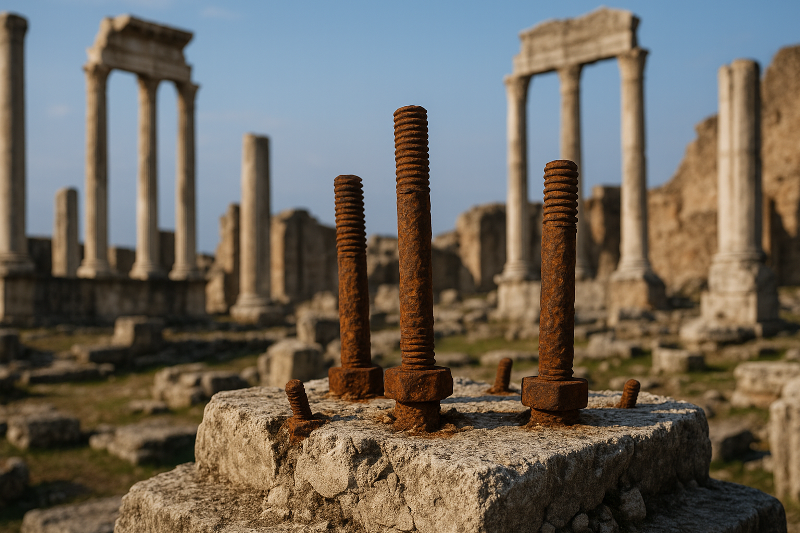
True, back then, they mostly used iron or bronze, and the technology was primitive. But the principle itself—creating a mechanical connection between the supporting structure and the foundation—remained unchanged. Today, this principle has merely received scientific justification and industrial implementation.
7. They "live" longer than it seems
The service life of a foundation bolt can reach 50–100 years or even more—with the right choice of material and operating conditions. In historic buildings dating back to the 19th century, the original bolts are still in use!
Of course, this doesn't mean they shouldn't be checked, especially in older industrial areas where bolts were exposed to vibration, chemical fumes, and overload. But a properly designed fastening system contributes to the longevity of the entire structure.
8. Corrosion is the main enemy of foundation bolts
Because bolts are often located in aggressive environments—underground, in high-moisture concrete, or in industrial settings—they are susceptible to corrosion. Even minor rusting can cause the fastener to loosen over time.
To avoid this, use:
- galvanization — the most common method of protection,
- stainless steel - for especially important objects,
- epoxy coatings - especially in chemical and petrochemical industries,
- cathodic protection - in marine and underground structures.
Sometimes the bolts even «die» before the structure itself and require replacement – especially in older buildings.
9. They save lives during earthquakes
In seismically active regions, foundation bolts are designed to withstand dynamic loads. They don't just hold the structure in place—they allow it to "play" slightly, absorbing the energy of tremors.
Modern earthquake-resistant bolts:
- have increased plasticity,
- capable of withstanding multiple deformation cycles,
- sometimes equipped with damping elements.
Thanks to such solutions, buildings do not collapse instantly, but give people precious seconds to evacuate.
10. Foundation bolts are a symbol of engineering trust
Ultimately, foundation bolts are more than just metal in concrete. They symbolize that even the most ambitious projects begin small: with precise calculations, reliable fastening, and trust in every structural element.
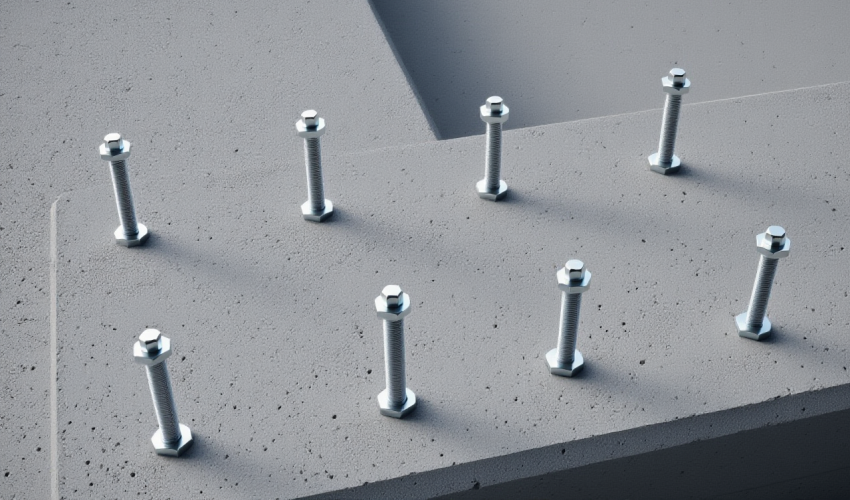
Engineers and builders know: if a bolt is installed correctly, the building will stand. If not, everything will collapse. Therefore, foundation bolts are not just a technical detail, but a philosophy of reliability embodied in metal.
Conclusion
Foundation bolts are a perfect example of how modest and unnoticeable elements can play a decisive role in a world of giants. They don't adorn facades or feature prominently in advertisements, yet they support the weight of industry, infrastructure, and modern civilization. Next time you pass a construction site, think of these unseen heroes—and you'll feel the ground beneath your feet in a completely different way.