

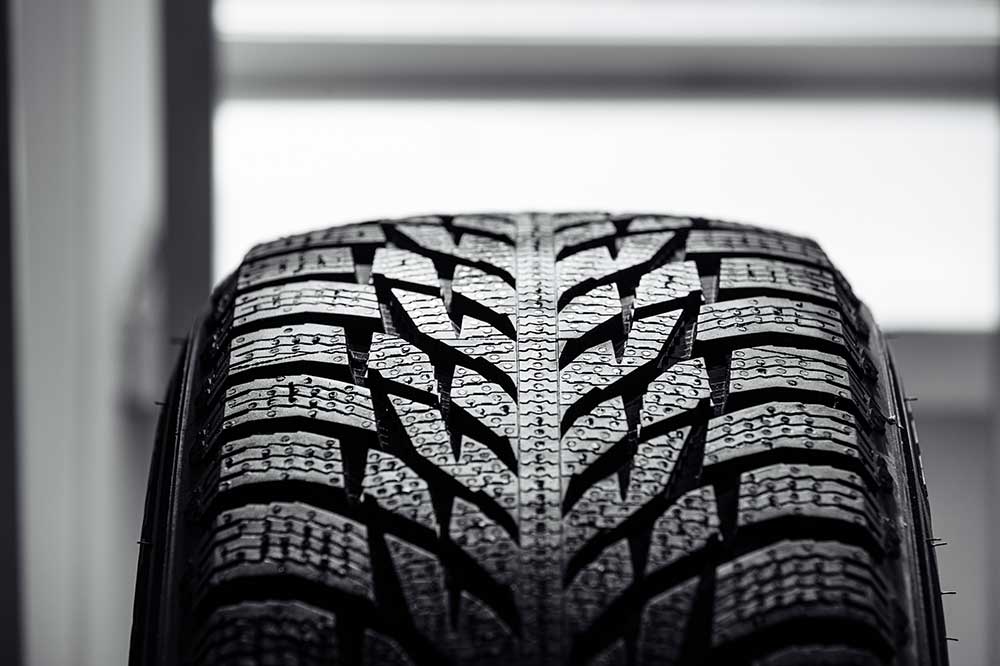
Winter tires have a softer rubber compound that doesn't harden in cold weather and a deeper tread with multiple sipes that bite into snow and ice; summer tires have a harder compound and a tread designed for dry and wet pavement in warm weather. Each tire performs best in its own temperature range. Summer tires lose grip in winter, while winter tires wear out faster in summer and have poorer handling.
To sum it up
- Compound: In winter it remains flexible at low temperatures, in summer it becomes harder and more resistant to heat.
- Tread: The winter one is deeper, with a dense network of lamellas, while the summer one has larger blocks and wide drainage channels.
- Marking: A real winter tire can be recognized by the symbol 3PMSF (snowflake against the background of a mountain peak), the inscription «M+S» alone is not enough.
- Suggested starting point: It is generally accepted in the industry that the acceptable limit is approximately 7°C from the average daily temperature.
The rubber compound is the most important difference.
Rubber in summer tires It's harder. This allows the tire to grip the road better in warm weather, provide precise handling, and wear more slowly. At low temperatures, the same rubber hardens and loses grip—even on dry, cold pavement.
Winter tire It has a compound with a higher content of components that maintain its elasticity in cold weather. The rubber adapts better to uneven surfaces, including cold and icy ones. The tradeoff is that in hot weather, such a tire becomes too soft: it wears faster, braking distances increase, and handling is reduced.
Winter and summer tire tread
Tread winter tires usually deeper and has many narrow lamellas . Their edges dig into snow and ice, and the grooves trap snow, improving traction on snowy roads (snow adheres well to snow). Wider grooves also help clear slush.
Tread summer tires It has larger, stiffer blocks and fewer sipes. This ensures a larger contact patch on dry roads and cornering stability, while wide longitudinal grooves channel water away and reduce the risk of aquaplaning during summer rains.
How to recognize a winter tire? 3PMSF and M+S markings.
There must be a symbol on the sidewall of the winter tire 3PMSF ( Three Peak Mountain Snow Flake ) — a snowflake against a backdrop of a three-peaked mountain. This symbol can only be applied after the tire has passed a snow-covered road test, confirming its winter performance. Good all-season tires also bear this symbol.
Marking M+S ( Mud and "Snow" is simply a manufacturer's statement about the tread pattern, not requiring mandatory testing. It can be found, for example, on some SUV and off-road vehicle tires. The M+S marking alone does not guarantee a tire's suitability for winter conditions, and in some countries, it is not considered a winter tire.
Comparison table of winter and summer tires
| Characteristic | Winter tires | Summer tires |
|---|---|---|
| Rubber compound | Soft and elastic in the cold | Harder, more resistant to high temperatures. |
| tread | Deeper, with a dense network of plates. | Large blocks, fewer cuts, wide drainage channels |
| the best conditions | Cold, snow, slush, ice | Warm, dry and wet surfaces |
| Designation | Designation 3PMSF (often also M+S) | Winter symbols are missing |
| Consumption in hot weather | Fast | Slow down |
| Recommended minimum tread depth | Experts recommend replacing it after approximately 4 mm. | Experts recommend replacing it after approximately 3 mm. |
| Legal minimum in Poland | 1.6 mm | 1.6 mm |
When should you switch to winter tires and is it necessary?
Tire manufacturers and repair shops use the generally accepted 7°C rule If the average daytime temperature remains below this value, it's advisable to install winter tires, and if it consistently exceeds this value in spring, it's time to switch to summer tires. This is more of a rule of thumb than a guideline. In Poland, tire changes usually occur in October-November and March-April, but it's better to check the weather forecast rather than the calendar.
There is no legal requirement to use winter tires in Poland. Similar regulations were proposed previously but were not adopted. However, general requirements apply: tread thickness must be at least 1.6 mm, and tires with the same tread pattern must be mounted on the same axle. Regulations are subject to change, so it's worth checking current legislation before the season begins.
The situation is different abroad. In Germany, winter or all-season tires with the 3PMSF marking are required in winter conditions, while in Austria and the Czech Republic, seasonal regulations apply, along with a minimum tread depth of 4 mm. Before a winter trip, check the current regulations in your destination country, for example, on the websites of automobile clubs or embassies.
Frequently Asked Questions (FAQ)
Is it possible to drive on winter tires in summer?
Polish law doesn't prohibit this, but it's not a good idea. In hot weather, soft rubber compounds wear quickly, increasing braking distances and reducing cornering precision. It's best to store winter tires until next season.
Are winter tires mandatory in Poland?
No, there is no legal requirement to use winter tires in Poland. However, police can fine drivers for tires in poor technical condition, for example, with a tread thickness of less than 1.6 mm.
How to check if a tire is suitable for winter?
Look for the 3PMSF symbol on the tire sidewall—a snowflake against a backdrop of a three-peaked mountain. The M+S marking itself is merely a manufacturer's statement and does not confirm snow testing.
At what temperature should you switch to winter tires?
The most commonly accepted limit is approximately 7°C for the average daily temperature. When the temperature remains below this level, winter tires provide better traction than summer tires.
Will all-season tires replace winter and summer tires?
All-season tires with the 3PMSF marking represent a compromise: they perform well in mild winters and primarily in urban conditions. In regions with frequent snowfalls or high mileage, seasonal tires typically perform better in extreme conditions.
See also
- What is the difference between enduro and motocross?
- What is the difference between 5w40 and 10w40 oils?
- What is the difference between 5w30 and 5w40 oils?
- What is the difference between a freeway and a highway?