


When people talk about the beauty of Russia, images of majestic mountains and stunning nature flash through their minds. However, behind this glittering façade lies another side: the problem of urban pollution, which continues to plague society. In this article, we will take a look at Russia's most polluted cities, uncover the causes and consequences of this problem, and discuss possible solutions.
What distinguishes a "dirty" city from a "clean" one? No, we're not talking about the work of public utilities or the janitors' broom skills—this time, let's talk about the environment. It's no secret that many city residents, especially large ones and those with large industrial facilities nearby, complain about the environment. And these complaints are not far-fetched—according to statistics, up to 140,000 residents of the Russian Federation die from environmental-related illnesses every year—about 51,000 of the total death toll.
Below is a list of the dirtiest cities in Russia, whose environmental conditions can pose a health hazard.
1. Bratsk

Bratsk tops the list of Russia's 10 most polluted cities. Scientists believe the city's environmental situation is to blame for the increased incidence of cancer among residents. If air pollution remains at the current level, it will only get worse. The cause, as usual, is a number of large industrial plants located within the city limits, including a pulp and paper mill, an aluminum smelter, and a hydroelectric power station. Residents of the central district, where the winds carry all the distinctive industrial odors, are particularly troubled.

In addition to emissions from industrial plants, Bratsk's atmosphere is polluted in the summer by regular forest fires, which burn out vast tracts of land each year.
Fortunately, the city's residents have a respite – the "Bratskoye More," or reservoir, where no one dumps wastewater and where you can swim and sunbathe safely and peacefully.
2. Novokuznetsk

Another large industrial Siberian city with an exceptionally unfortunate location—its territory is surrounded by mountains, which prevent winds from blowing through the city. As a result, smog from automobile and industrial emissions stagnates over the city.
Novokuznetsk is home to numerous enterprises, including ferrous and non-ferrous metallurgy plants, coal plants, and thermal power plants, essential to any large city. As usual, thrifty owners are slow to upgrade their equipment, resulting in over 801 TP3T of harmful substances easily passing through filters. Consequently, up to 300 tons of harmful substances are released into the city's atmosphere each year, inhaled by Novokuznetsk residents due to poor air circulation.

The city also faces a problem with landfills—the existing ones can't handle the volume of waste. Consequently, random landfills are springing up, where citizens dump their waste, adding a unique flavor to the city's atmosphere.
3. Chelyabinsk

A ranking of Russia's dirtiest cities would be incomplete without the "city of tough men." Historically, the concentration of large industrial enterprises is highest beyond the Urals. Therefore, Siberians suffer the most from poor environmental conditions. Chelyabinsk is no exception. Numerous industrial facilities are located both within the city and beyond. As a result, Chelyabinsk residents breathe air with elevated levels of various harmful chemicals, such as phenol, hydrogen sulfide, formaldehyde, and so on. Smog hangs over the city almost 24/7.

The city's location adds to the problem—it's windless most days (a third to half of the days per year), with only a light breeze at most. Without air movement, air masses don't mix, and emissions accumulate in the lower atmosphere. And Chelyabinsk residents are forced to breathe it. The city also ranks among the worst in Russia for quality of life.
Another reason for the city's poor environmental situation is the lack of a place to dump trash. The city's main landfill was completely full a quarter of a century ago, and this gigantic mountain of garbage occasionally bursts into flames during the summer months, adding to the problems for Chelyabinsk residents. Oh, and swimming in the bodies of water near Chelyabinsk is highly discouraged.
4. Nizhny Tagil

Nizhny Tagil received a special mention in the presidential decree issued in May as the only city in the Sverdlovsk region mandated by the highest authority to reduce city air emissions by at least 20%. The party said, "We must!" The bourgeoisie responded, "We have!" Environmental organizations in the city note the increased efforts of factory owners to comply with the decree. This, however, will be a significant blow to their finances, as environmental protection is a costly matter. According to estimates, at least 3% of budget funds should be allocated to maintain the city's environmental status at an acceptable level. In reality, naturally, no more than 0.02% is allocated.

Nizhny Tagil has several large industrial plants that contribute to pollution, including Uralvagonzavod, famous from YouTube videos. The Nizhny Tagil Iron and Steel Works leads the way in emissions. Besides polluting the air, these plants also pollute the water by discharging wastewater into water sources. However, the situation is no longer as catastrophic as it was in the early 1990s – many "dirty" plants have gone bankrupt and collapsed, while those that remain at least maintain some decorum.
5. Magnitogorsk

Magnitogorsk is also among the most polluted cities in Russia. The local iron and steel plant is one of the largest iron ore processing plants in the country. As a result, atmospheric concentrations of harmful substances are 10-20 times higher than normal, despite the best efforts of the plant's management.
The waters of the Ural River, which unfortunately flows by, have also undergone changes: for the sake of the plant, the river was dammed, from where water is drawn for the plant's needs. However, the used water, although filtered, is discharged into the same river. As a result, eating fish caught there is literally life-threatening.
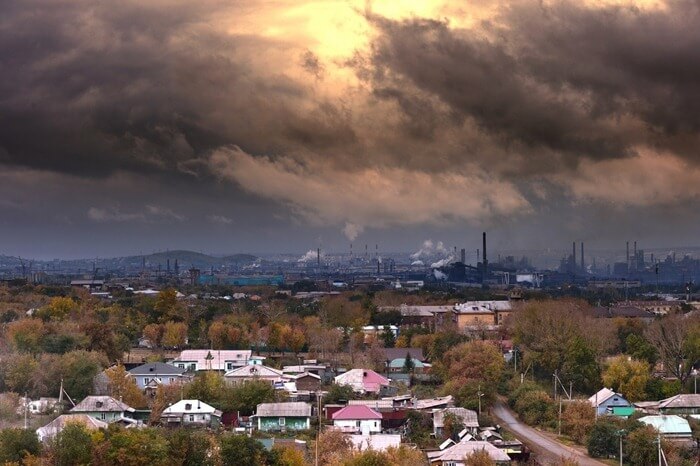
Residents of the left bank of the Ural River, where manufacturing is concentrated, are suffering the most. The city government has decided to build exclusively on the right bank of the Ural, where the environmental conditions are more or less favorable (and to relocate residents of the "left bank" there). In the future, plans are in place (someday, when funding allows), to build several small satellite towns of Magnitogorsk, locating them in forested areas and building roads into the city. Rumor has it that this will be cheaper than trying to modernize the city as it currently is.
6. Norilsk

The main cause of pollution in Norilsk is the local metallurgical plant, Norilsk Nickel. Every year, it generously releases two and a half million tons of sulfur dioxide into the air, blanketing the city.
As a result of the plant's operations and the poor condition of its treatment facilities, Norilsk's water takes on a unique turquoise-green hue due to elevated copper sulfate levels. The surrounding coniferous forests are leafless, their needles scorched by acid rain. Wastewater discharge has destroyed all flora and fauna in the lakes near the city. At least, thanks to strong winds, smog in Norilsk barely lingers.

It's no surprise that Norilsk is listed among the most polluted cities in Russia. The only consolation for Norilsk residents is the fact that Norilsk isn't yet ranked among the world's dirtiest cities. It's clearly outdone by cities in China and India, where industrial emissions are even worse.
7. Omsk

The city's environmental situation is best characterized by the presence of Siberia's largest oncology center. For several years now, Omsk has been ranked among the top five cities with the highest cancer rates. The city's numerous industrial enterprises contribute to the unfavorable environmental conditions. A poultry farm further contributes to the odors, discouraging residents of nearby neighborhoods from opening their windows to ventilate their apartments. Although there are no industrial enterprises in the city center, their absence is more than compensated for by the presence of cars.

The Irtysh River, on whose banks the city stands, although considerably shallower, can still pose a number of problems for those who dare to swim in it. It harbors E. coli, staphylococcus, and other bacteria that are eager to inhabit a human body.
True, since 2010, the city has been working to reduce emissions. To this end, filters to capture smoke particles have been installed at the thermal power plant, and the plant's equipment has been modernized. The only remaining issue is waste, which is critical in Omsk: two of its three landfills are closed, and the third cannot handle the enormous volumes of waste emitted daily by the city of over a million.
8. Krasnoyarsk

Krasnoyarsk has long been firmly within the ecological safety red line. Scientists believe that if things continue as they are, within 70 years the city will be uninhabitable. Except for cockroaches—they'll survive everywhere.
In February 2018, the city was filled with a yellow fog, almost like something out of a Stephen King novel. Residents, especially those with respiratory illnesses, were advised not to go outside at all. The concentration of harmful substances in this yellow fog far exceeded the norm. Residents also regularly observe a phenomenon they call "black sky." It's not yet pitch black, more like a dark gray, but we suspect more is yet to come.

As usual, industrial enterprises (especially the aluminum smelter, which is constantly expanding its capacity) and thermal power plants are to blame; vehicle emissions account for no more than 351 TP3T of the city's unique atmosphere. But human greed is the biggest culprit – both large and private enterprises use very cheap, low-quality coal as fuel. Electric boilers are not affordable for everyone due to high prices. So they heat their homes with them. This is how soot settles on windows, walls, and the ground.
9. Lipetsk

Like Norilsk, Lipetsk suffers from the consequences of having a large industrial plant within its city limits. The Novolipetsk Iron and Steel Works generously "gives" Lipetsk residents 290,000 tons of harmful emissions annually. Although it is located on the low left bank of the Voronezh River, while residential buildings are on the higher right bank, the characteristic odors of the large industrial plant, including the stench of hydrogen sulfide, still permeate residents' apartments when the southeast wind blows.
The city is also regularly rocked by scandals: someone is quietly releasing harmful substances into the air at night in quantities significantly exceeding legal limits. But who is doing this remains a mystery.

Besides the factory, cars also add their own unique flavor to the city's atmosphere. Approximately one-third of the harmful substances in the air are caused by their wheels. Concerned residents of Lipetsk have introduced continuous air quality monitoring (incidentally, Lipetsk is the only city in Russia to implement such a system) and are attempting to modernize the city's traffic system to reduce emissions. However, as some say, this is primarily done to embezzle funds, as the results are nowhere in sight.
The townspeople are lucky only with water – the underground sources have not yet been affected by industrial damage.
10. Chita

For years now, Chita has been ranked among the most polluted cities in Russia (the list includes nine other sufferers, besides Chita). Paradoxically for such a small city (Chita's population is less than 350,000), one of the reasons is the number of cars per capita. No, not even Moscow or St. Petersburg, but Vladivostok, which outshines Chita residents in their love of cars. Situated in a basin, surrounded by hills, and built in densely packed high-rise buildings, the city has virtually no air circulation. Although strong winds often blow, Chita is blanketed in a thick blanket of smog in winter.

Adding further flavor to the hellish mix is the city's ancient heating system—the combined heat and power plants (CHPs), both primary and secondary—as well as the city's boiler houses, which use coal and fuel oil as fuel. As Chita residents say, just drive a few kilometers outside the city and you'll see a dirty brown fog hanging over it, pierced only by the black smoke from the power plants. They say, however, that the boiler houses are being converted to more modern fuels, but the results are not yet visible—Chita remains one of the dirtiest cities in Russia.
8. Cherepovets
Despite its small population (just over 300,000), Cherepovets is a major industrial center in Russia, home to the country's second-largest steel mill. Additionally, two other industrial plants operate there, classified as having the highest environmental hazard category, Category I.
And if we add to this that in addition to these three enterprises, there are about 300 more factories in the city... It is not surprising that cancer, and lung cancer in particular, is the second most common disease in the city.
12. Mednogorsk
The city of Mednogorsk, located in the Orenburg region, rounds out the list. It's one of the so-called "monotowns"—settlements that sprang up around a large enterprise or mine to provide workers with a place to live and their families with a place to study and shop.
Mednogorsk grew around a copper pyrite deposit, where a copper-sulfur plant was built in the 1930s. After the mine's closure, the plant continued to operate, but switched to imported raw materials. The city also has another large plant, a remnant of the Soviet era: Uralelectro.
But "industrial" air isn't Mednogorsk's only environmental problem. The mine left behind a legacy—a copper quarry. Over the past half-century, water has flowed into it, turning a toxic green and beginning to seep into the groundwater, gradually poisoning it. Environmental experts have discovered record levels of copper and zinc in the local river, exceeding legal limits by more than 30 times!
Factors of air pollution and formation of NMUs
Smog—a toxic fog containing numerous harmful substances that can harm the respiratory system—is primarily responsible for human illness. And not only that: polluted air can disrupt the immune system, cause high blood pressure, trigger birth defects, and exacerbate cardiovascular diseases.
Smog is caused by car exhaust (the more cars there are in a city, the harder it is to breathe), as well as by harmful emissions if industrial enterprises are located within the city limits or in its immediate vicinity.
The location and layout of the city plays an important role – if it is located in a poorly ventilated lowland, then the chances of residents contracting respiratory diseases become higher
How will the environment in Russia be improved?
In addition to compiling this list, the Ministry of Natural Resources also proposed a bill on environmental information to the State Duma.
Officials claimed that a program to improve environmental safety would be launched in 2019, but as we see in 2027, nothing has changed. The environmental regulation system required polluting enterprises to transition to more modern and environmentally friendly production methods. The changes were primarily intended to affect the 300 factories responsible for more than half of all industrial emissions in Russia.
So for now, residents of these cities on the list will have to breathe what they have or look for another place to live.