

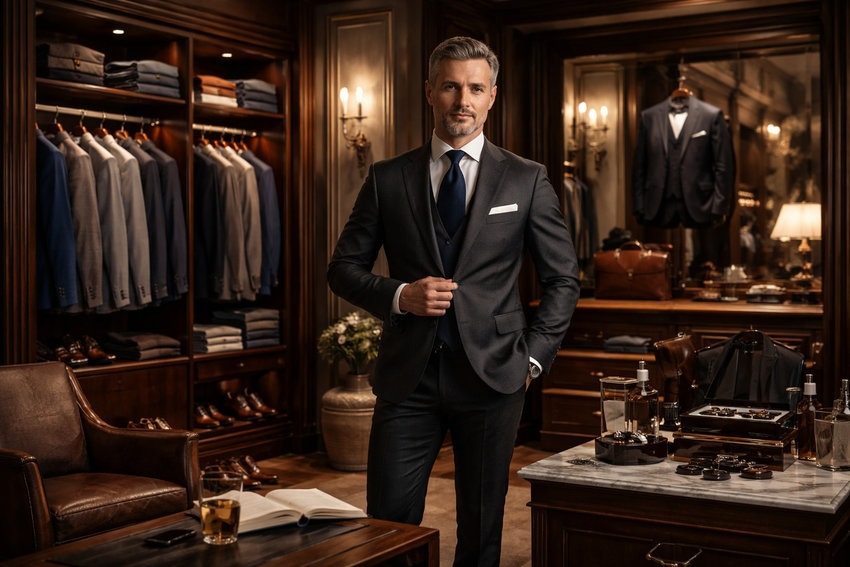
Assembling a prestigious men's wardrobe is not so much a financial task as a philosophical one. It's not about the number of suits in your closet, but rather the extent to which each item reflects your personality, lifestyle, and inner standards. In a world where everything speeds up and attention is distracted, true elegance is becoming rare—and therefore especially valuable. But how can you build such a wardrobe when boutiques offer monotonous mass-produced items, and trends change faster than you can keep up with them?
The answer lies not in the quantity of purchases, but in the approach: in bespoke tailoring, in a thoughtful capsule collection, in details that remain invisible to the uninitiated but are instantly recognizable to those in the know. This article is not a guide to quick spending, but an invitation to make informed choices: how to assemble a gentleman's wardrobe in which every item contributes to your image, not just hangs on a hanger.
Appearance as a calling card of a successful man
In a world where first impressions are formed in seconds, a man's appearance is not just a reflection of taste but his invisible resume. Without words, it communicates status, discipline, and respect for oneself and others. Even the most brilliant mind risks going unnoticed if its owner shows up to a business meeting in a wrinkled shirt or to a social event in an ill-fitting suit. Today, when information noise forces people to judge by visuals, wardrobe is becoming a strategic tool, not just a collection of clothes.
Fashion trends come and go with a speed comparable to the life cycle of a smartphone. Bright prints, extravagant cuts, experiments with proportions—all of this may look trendy today, but in two or three seasons, it will become a fashion fad.

But the classic style, refined over centuries, remains an unwavering reference point for those who value timeless elegance over fleeting popularity. It forms the foundation of the gentleman's wardrobe, whose image says:
«I know who I am and I don't need to confirm it through flashy logos or fashion fads.».
The Basics of a Man's Wardrobe: A Capsule for a Status Man
Creating a truly prestigious wardrobe doesn't start with searching for the latest fashion hit, but with creating a classic capsule wardrobe—a set of basic pieces that can be combined in any way and are suitable for most occasions, from a business presentation to an intimate dinner. This approach eliminates impulse purchases and ensures you're always impeccably dressed.
- The heart of the male capsule — is a two-piece suit. Not just any suit, but one that perfectly contours to your figure. A classic silhouette in a neutral palette (anthracite, navy, or dark gray) becomes a versatile tool: pair it with a white shirt for a flight; with a light blue suit for a business breakfast; or with a cashmere sweater for an informal meeting. It's important that the jacket and trousers are made from the same fabric—this ensures a harmonious blend of colors and textures.
- The second whale — shirts. Three or four styles are sufficient: white and light blue with a small check or stripe, plus one or two in a more subdued shade (light gray, beige). The quality of the fabric is crucial here: high-density cotton (120–180 threads per inch) doesn't wrinkle, retains its shape, and feels like a second skin.
- The third element — outerwear. A subtle but important rule: a coat should be one or two sizes larger than a suit so it fits over it without feeling too tight. A classic trench coat or a straight-cut wool coat in black, beige, or gray is timeless and timeless.
The key principle of a capsule wardrobe is cohesion. Each new item should pair perfectly with at least three existing ones. This not only simplifies choosing an outfit in the morning but also creates a sense of cohesive, well-thought-out style—the hallmark of a true gentleman.

Shoes and accessories: details that make all the difference
If a suit is a man's voice, then shoes are his signature. Factory-made shoes, even the most expensive, are created using generic patterns. They rarely take into account the individual characteristics of the foot: arch, toe width, gait. As a result, even Italian shoes can cause discomfort after just an hour. Handmade shoes, by contrast, begin with a custom-made last—an exact replica of your foot. These shoes are not just comfortable: over time, they fit like a glove, becoming an extension of your body. Furthermore, hand-stitched lasts, genuine leather soles, and multi-layer construction ensure not only durability but also incredible cushioning.
Accessories are the finishing touches that transform an outfit into a complete look. The wrong tie or belt can ruin even the most expensive suit. Three rules are essential:
- Color harmony: belt and shoes - always in the same shade of leather.
- Minimalism: Avoid logos, large buckles, and bright watches with massive dials.
- Quality of materials: A silk tie, a linen handkerchief in the breast pocket, a watch with a cowhide leather strap—these details are noticed even if they are not mentioned out loud.
A good accessory doesn't shout about itself - it speaks for you.
Atmosphere and Service: Why a Premium Atelier Isn't a Store
Buying clothes in a boutique is a transaction. A visit to a premium atelier is the beginning of a long dialogue between the tailor and the client. There's no rush, no crowds, and no pressure from salespeople. Just a relaxed atmosphere, individual attention, and the understanding that you're not just here to «buy a suit» but to create part of your image.
The process begins with a personal meeting, where the stylist learns not only about your style preferences but also about your lifestyle, professional background, and even your habits. This allows us to offer solutions that are not only beautiful but also functional. Taking your measurements becomes a ritual: dozens of parameters, taking into account your posture, even the movement of your shoulders—all of this is recorded with pinpoint precision.
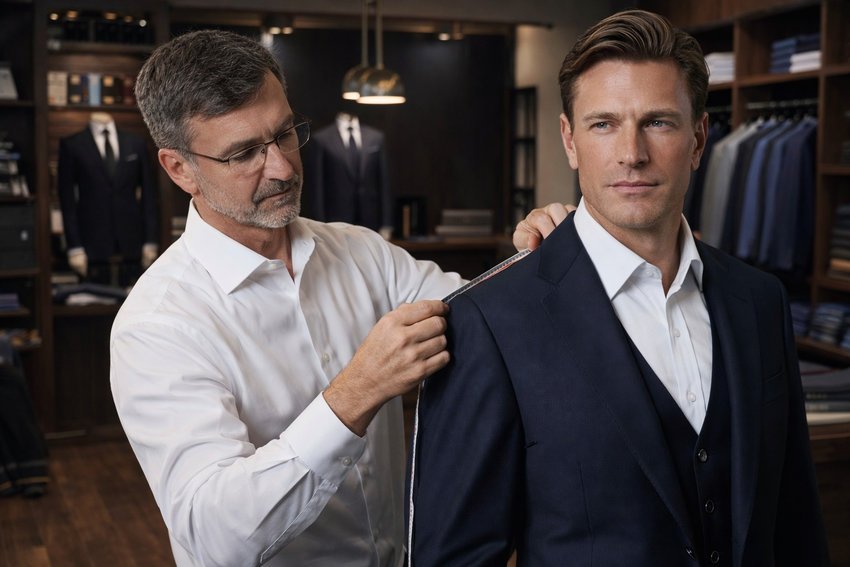
A fitting at such a studio isn't like standing in front of a mirror in a dressing room, but rather a moment of co-creation. The stylist makes adjustments directly to you, explaining why a particular seam will fall a certain way and how it will affect the silhouette and comfort. It's not just tailoring—it's a collaborative creation, in which you're not the buyer, but the co-creator.
The benefits of turnkey tailoring: a wardrobe as a single system
One of the main advantages of hiring a professional tailor is the opportunity to create an entire wardrobe from scratch. After the first visit, when all measurements have been taken and basic preferences for cut, style, and fabrics have been determined, all subsequent items are tailored without the need for repeat fittings. This saves not only time but also stress: you know for sure that every new shirt or jacket will fit perfectly.
Furthermore, single-source tailoring ensures a consistent style. Sleeve cut, collar height, and lapel shape—all these elements remain consistent throughout the wardrobe, creating a sense of cohesion. The client isn't «assembling» an outfit from various sources, but rather receives a well-thought-out system in which each detail complements the others.
Quality control of materials is paramount. Ateliers with their own production facilities, like Tailor Craft, clients are offered only proven premium fabrics from leading European manufacturers: Dormeuil, Holland & Sherry, and Loro Piana. This isn't just beautiful fabric—it's an investment in durability, appearance, and comfort. These materials don't fade, don't shrink after dry cleaning, and even improve their texture over time.

Finally, turnkey tailoring offers the convenience of planning. You can coordinate your seasonal wardrobe with the tailor in advance: a spring suit, summer shirts, a mid-season coat—everything will be ready on time, without fuss or rush.
Conclusion: Don't compromise, create a standard
Assembling a prestigious wardrobe today means making a conscious choice in favor of quality over quantity; individuality over mass production; long-term value over fleeting fashion. A gentleman doesn't compromise between comfort and elegance, between tradition and modernity. He creates his own standard—and sticks to it.
If you're ready to stop adapting to what stores offer and start building a wardrobe that reflects your personality and status, it's time to turn to artisans for whom tailoring isn't just a craft, but an art. Because true style begins not with a purchase, but with a dialogue. A dialogue in which you are heard, understood, and your ideal is embodied in every stitch.