

Inspirational quotes about mistakes are so ubiquitous that they fill entire books, not to mention all those stories about how inventions Or other discoveries were made by accident. Well, it's time to look at the other side of the coin: mistakes that were borne primarily by thousands, perhaps millions, of people with virtually no say in the decision-making process, and who very often paid with their lives. In some cases, this could affect all of humanity, and it will continue to do so for the foreseeable future.
10. Handcart expedition
In 1856, Mormon followers brought 1,100 people from the United Kingdom and Scandinavia to Missouri, destined to move toward what Brigham Young described as Zion in Utah to escape the persecution they were facing in the states then being admitted to the Union. Since the new converts were too poor to purchase covered wagons or oxen for transport, the expedition turned to handcarts. It was decided that the alternative would not only be cheaper, but also that the light loads could be moved quickly enough to get the newcomers to Zion within two months.
The calculations of Young and the other organizers were wrong in almost every way. First, they overestimated the strength of the green wood used for the wagons, meaning they soon had dozens of broken pieces. On the other hand, the groups were allowed to set out in August Instead of the recommended departure in May, supplies such as blankets, which could have saved lives, were not simply abandoned along the way but actively burned to remove the temptation to return for them later. No supply zones were established for the new converts, and no existing settlements were informed. Salt Lake City, the main population from which any rescue operation could have been launched, didn't even know they were arriving.
As a result210 people died from cold, hunger, and other causes on the road to Zion. In essence, Young inflicted damage on the Mormon herd equal to five of the Donner Party's disasters. Instead of admitting this, church leaders turned the handcarts into an important religious symbol and a tribute to the faith and resilience of their followers, including using them in reenactments for generations.
9. Yamamoto's Rejected War Game
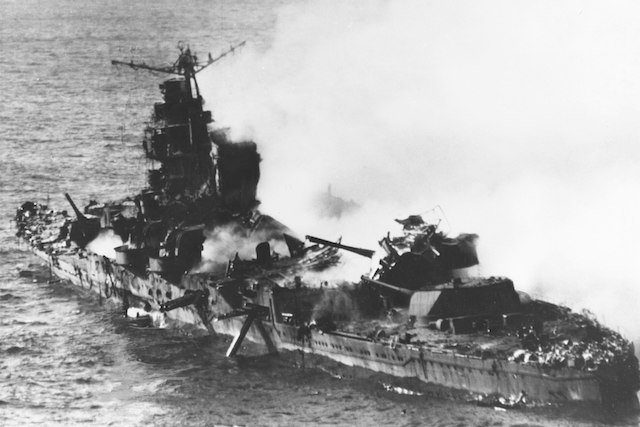
Battle of Midway 1942 , The attack, which resulted in the destruction of four Japanese aircraft carriers, is widely regarded as the turning point in the Pacific War, making Japan's defeat inevitable. What wasn't inevitable, of course, was that on the afternoon of June 4, Japanese carriers off Alaska's Aleutian Islands had to refuel and rearm their aircraft (switching from dive bombs to torpedoes, the preferred anti-ship weapon at the time), just in time for an American air attack. In fact, Japanese commanders had dire warnings that such a thing might happen.
On May 1, the Japanese naval battle command assembled for a war game to test contingencies for their plan to attack the Aleutians. While testing the feasibility of attacking carriers without air cover (the main difference between the initial test conditions and the reality of June 4 was that in reality, the aircraft were still on the carriers, while in the game, they were assumed to be away from their bombing mission), a dice roll was made to determine the damage the American bombers could inflict. When the result was a heavy loss of one carrier and damage to another, Admiral Matome Ugaki The conclusions were reversed, not believing that American bombers could inflict nearly as much damage even if they caught carriers with their defenses down, and no one questioned the theorizing or reassessed the strategy. This downplaying of the crisis influenced the Japanese decision-making process in such a way that at the crucial moment, they found themselves in the position of sitting ducks.
8. Persecution of LGBT people in Cuba
Even before the Cuban Revolution, homosexuality was taboo on the island nation. In the 1960s, this situation worsened: homosexuals were arrested, lost their jobs, or, worst of all, sent en masse to labor camps known as «military-industrial assistance camps.» It was only in 1979 that the Cuban government decriminalized homosexuality, as long as it was not «publicly manifested.».
Unusually for a man of his position, in 2010 Fidel Castro He admitted that committing such horrific acts against Cuba's LGBT community was a mistake. Moreover, he acknowledged that it was his fault. Some claim it was just part of a public relations campaign spearheaded by his niece. Mariela Castro . However, it was an unusual effort for a former head of state in a communist country.
7. The traitorous Minister of War
When discussing the blunders of the American Civil War, the focus is usually on a single doomed attack, such as Pickett's Charge or Marye's Heights at Fredericksburg. However, the thousands of deaths caused by these attacks pale in comparison to the mistake that made the war possible. It was then that President James Buchanan appointed former Virginia Governor John Floyd as Secretary of War. в In 1857.
As Secretary of War, Floyd shipped vast portions of Federal arsenals to isolated locations where they could be captured without a shot being fired by the newly formed Confederate militias, allowing the seceding states to field thousands of artillery pieces, even though there were virtually no gun factories in the entire South. He even went so far as to secretly sell 10,000 rifles pro-Confederate militias in South Carolina. If there was any doubt about where his true sympathies lay, when the Civil War began, he joined the Confederacy as a general (though, given his disastrous actions at Fort Donelson, future President Ulysses S. Grant said that joining the Confederacy was the best service he could have rendered the Union). In short, Floyd was the single person most responsible for the 600,000 deaths during the Civil War, as opposed to the near-zero that resulted from South Carolina's failed secession in 1833.
6. London bombing on August 24.
After conquering France, Hitler's plans for Britain were surprisingly lenient. He intended to make peace before invading the Soviet Union (more on that later). To this end, an important aspect Führer Directive No. 17 was that the Terrorist Force «reserves the right to take decisions on terrorist attacks as retaliatory measures» in the interests of concentrating offensive power on the RAF and preventing increased British support for the war.
Instead, on August 24, Luftwaffe crews accidentally dropped bombs on London, and in retaliation August 25 RAF bombs were dropped on Berlin. As a result, the Luftwaffe's vital resources were wasted trying to kill civilians instead of weakening the RAF, and the resolve to end the war faded. This anonymous bomber crew inadvertently rendered the Allied war effort the greatest propaganda service of the war.
5. Potato blight
As of 2016, Ireland's population had still not recovered from the Great Famine of 1845-1849. A million people were forced to flee the island, and another million died of starvation, resulting in a population decline of as much as 25%. Considering that the potato blight that caused this disaster was imported from mold on ships from North America, it may be the worst American export in history.
British laws and policies were almost deliberately useless. First, for many years official intervention was not permitted, and Irish grain exports to England continued. On the other hand, Poor Law 1838 The famine sent the bankrupt and evicted to workhouses, which naturally greatly discouraged those desperate to seek relief and left many communities without the laborers needed for their fields. Absentee landowners in England were generally reluctant to contribute to relief programs, and many primarily expanded their landholdings, harboring suspicions that the famine was, if not intentional on England's part, then at least not something they were overly motivated to remedy.
4. Famine in Orissa
When it comes to British policy, which provides ineffective measures to counteract famine, this historical catastrophe is so unclear that even in TopTenz list about famine, it was not included. And yet it cost humanity a million lives in 1866. To a large extent, this was due to the fact that Ost- India Company devastated the textile industry in the Indian region of Orissa, making the economy much more vulnerable to the vagaries of weather and thus allowing a severe monsoon crisis to exact even heavier toll.
The official imperial response was to remain hands-off, and especially not to regulate grain prices, which would have made supplies more affordable for the general population. The human cost of this decision cost many communities up to a third of their population. The British Empire would eventually pay a heavy price for this. laissez-faire approach , as famine became the driving force behind the development of Indian nationalism.
3. Kyiv Order of Stalin
In terms of direct losses of personnel, no decision of the military campaign was as devastating for the military as Stalin's orders for the defense of Kyiv, which began on September 7, 1941. By September 9, 1941, Field Marshal Budyonny saw that the situation was hopeless and ordered an «orderly, phased withdrawal» of all Soviet troops from Kyiv. Joseph Stalin categorically forbade this and, surprisingly frankly, ordered: «Stand and hold, and if necessary, die !»
Approximately 600,000 Soviet soldiers will follow the second half of this order either in combat or later in prisons/death camps. Of the lined-up forces, only approximately 15 000 managed to avoid encirclement. Later historians argued that the battle may still have saved the Soviet Union, because Hitler diverted tens of thousands of soldiers who would otherwise have taken Moscow to return to Ukraine. But there is little reason to believe they would not have been able to act as a deterrent had they not been encircled.
2. Cultural Revolution
The Cultural Revolution was a movement in China during the last 10 years of Chairman Mao Zedong's life, when intellectualism and the supposed emergence of a new bourgeoisie were purged from China. This largely took the form of the formation of paramilitary groups called «Red Guards» by closing schools and forcing students to persecute older adherents of traditionalist values and purely intellectual pursuits. Zedong would resort to sending Chinese troops against the Red Guard groups he himself had made possible, and the civil war would continue until 1977, when Deng Xiaopang (who had himself been ousted from power early in the revolution) assumed power and held that position for the next 20 years. By the end of the revolution, it had cost approximately 1.5 million lives .
Like Castro with the military-industrial aid camps, the Chinese Communist Party was ready to admit this fatal mistake. In May 2016 People's Daily on Tuesday« , the official newspaper of the Communist Party of China, declared that it would «never allow a mistake like the Cultural Revolution to be repeated.» The truth of this observation was clouded by the fact that even as the statement was being published, Beijing was officially celebrating the revolution, and many Chinese intellectuals argue that the economic reforms implemented during the purge allowed China to become the economic power it has become today.
1. Ethyl
TopTenz Thomas Midgley's work on leaded gasoline, introduced in 1923, spoke of the harm inflicted on workers producing tetraethyl, but this only scratched the surface of the damage that lead added to gasoline caused worldwide. It's difficult to say how many premature deaths, miscarriages, and nervous system damage it caused after forcing its inventor to spend months recovering. However, a 2011 California State University report, distributed by the United Nations, found that approximately 1.2 million premature deaths and approximately 125,000 miscarriages were prevented annually by phasing out leaded gasoline.
Moreover, $2.4 trillion in damage, including acid rain, was prevented. So, perhaps it could be said that the effort to phase out leaded gasoline, spearheaded by renowned scientist Clair Patterson, was one of the most under-the-radar efforts in human history.
Although global efforts began to phase out in 1971, several countries remained on the sidelines into the 21st century. This was largely due to infrastructural difficulties associated with retooling their oil industries to remove lead from the chemical process. Reluctant countries included Yemen, Iraq, and Afghanistan. The latter officially completed its phaseout in 2021. Leaded gasoline still directly and legally causes death and nervous breakdowns when used in small aircraft, so Thomas Midgley will likely continue to harm humanity for decades to come.
Is Dustin Koski's science fiction novel «A Tale of Magic Gone Wrong», the complete opposite of one of humanity's greatest mistakes? You'll have to read this to find out!