

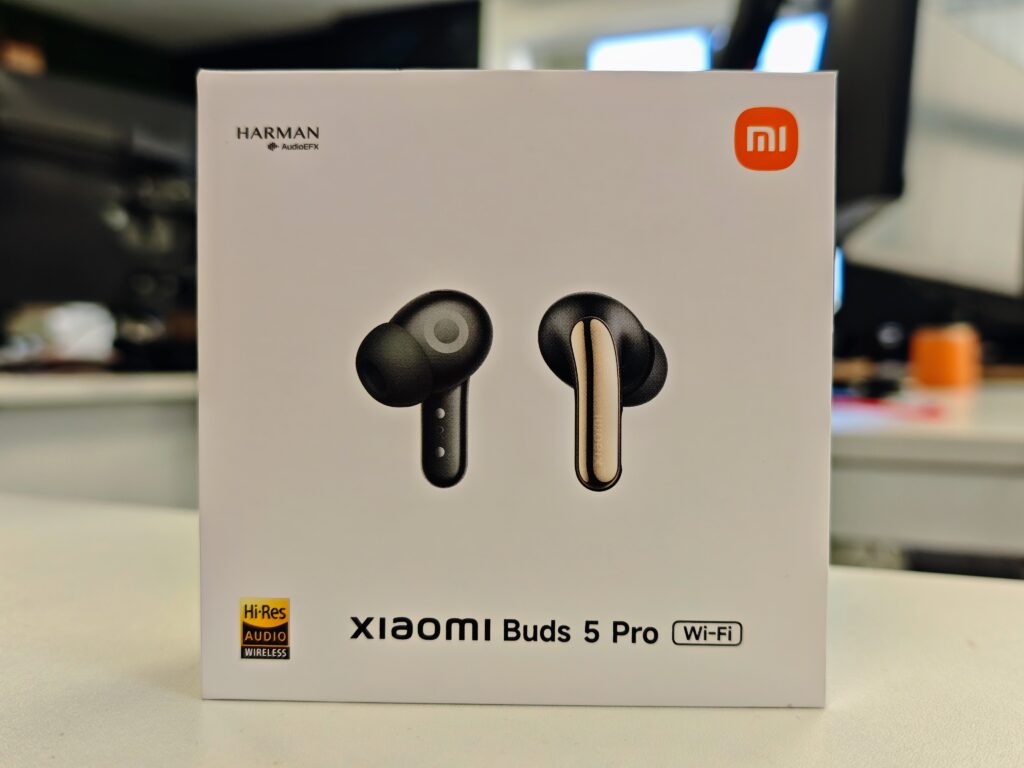
Xiaomi announced the global availability of the Xiaomi 15 smartphone and also unveiled the new Xiaomi Buds 5 Pro earbuds, which come in two variants: a standard model and a new Wi-Fi model that uses Snapdragon Sound Technology Suite with Qualcomm XPAN technology to stream audio at up to 4.2 Mbps, enabling a 96 kHz sampling rate with 24-bit audio depth, double the sampling rate of the standard model.
Specification
| Peculiarity | Xiaomi Buds 5 Pro (Wi-Fi) | Xiaomi Buds 5 Pro |
| Design | ||
| Weight | 5.6±0.1 g (per earphone) | 5.6±0.1 g (per earphone) |
| Color options | Translucent black | Ceramic White, Titanium Gray |
| Audio technology | ||
| Driver system | two-channel coaxial amplifier with three drivers | Coaxial three-driver dual amplifier |
| Drivers | 11mm dynamic driver, piezoelectric tweeter, planar driver | 11mm dynamic driver, piezoelectric tweeter, planar driver |
| Audio codecs | aptX™ Adaptive, aptX™ Lossless, AAC, SBC, LC3 | aptX™ Adaptive, aptX™ Lossless, AAC, SBC, LC3 |
| Sound quality | 96 kHz/24 bit, 4.2 Mbps via Wi-Fi | 48 kHz/24 bit, 2.1 Mbps |
| Sound settings | Setting up Harman AudioEFX | Setting up Harman AudioEFX |
| Noise reduction | ||
| ANK depth | Up to 55 dB at 5 kHz | Up to 55 dB at 5 kHz |
| Modes | Multi-level active noise cancellation modes | Multi-level active noise cancellation modes |
| Transparency | 3 transparency modes | 3 transparency modes |
| Connection | ||
| Bluetooth version | Bluetooth® 5.4 | Bluetooth® 5.4 |
| Range | Up to 10 meters | Up to 10 meters |
| Multi-device | Connecting two devices | Connecting two devices |
| Wi-Fi support | Yes | No |
| Battery life | ||
| One-time charge | Up to 10 o'clock | Up to 8 o'clock |
| With a cover | Up to 40 hours | Up to 40 hours |
| Fast charging | 4 hours after 10 minutes of charging | 4.5 hours after 10 minutes of charging |
| Charging port | Type-C | Type-C |
| Intelligent functions | ||
| Audio recording | Yes, by triple-clicking the button on the body. | Yes, by triple-clicking the button on the body. |
| AI-powered translation | Yes, it will be available from Q2 2027. | Yes, it will be available from Q2 2027. |
| AI Transcription | Yes, it will be available from Q2 2027. | Yes, it will be available from Q2 2027. |
| Spatial audio | Yes, with the possibility of personalization. | Yes, with the possibility of personalization. |
| Controls | Tap and swipe gestures | Tap and swipe gestures |
| Package contents | ||
| Included items | Headphones, Type-C charging cable, user manual, 4 pairs of ear tips. | Headphones, Type-C charging cable, user manual, 4 pairs of ear tips. |
Functions
Excellent sound system
The Xiaomi Buds 5 Pro (Wi-Fi) earbuds deliver exceptional sound quality thanks to a coaxial system with three drivers and two amplifiers. An 11mm dynamic driver with a dual magnetic structure delivers enhanced bass, a PZT piezoelectric tweeter delivers clear highs, and a planar driver extends the frequency range with minimal distortion. Support for 96 kHz/24-bit audio transmission, Snapdragon Sound Technology Suite, and Qualcomm XPAN technologies provide lossless audio transmission at 4.2 Mbps over Wi-Fi, delivering higher sound quality and better power efficiency than the standard Xiaomi Buds 5 Pro. Master tuning by the Harman Golden Ear Team creates balanced EQ profiles, and the built-in surround sound feature, personalized based on ear and head movement testing, delivers a fully immersive listening experience.
Smart features for any environment
The Xiaomi Buds 5 Pro (Wi-Fi) earbuds offer practical features for a variety of situations. The built-in audio recording feature lets you record conversations with a triple-click of the button on the case, while the AI-powered translation and transcription feature converts recordings into text for easier multilingual communication. These features work in conjunction with ultra-deep hybrid active noise cancellation (ANC) technology, which provides up to 55 dB of noise reduction to block out ambient noise. With adjustable ANC levels, the earbuds seamlessly transition between different scenarios, whether listening to music or participating in meetings. The Xiaomi Buds 5 Pro (Wi-Fi) maintain high sound quality and functionality in a variety of settings.
Practical design and battery performance
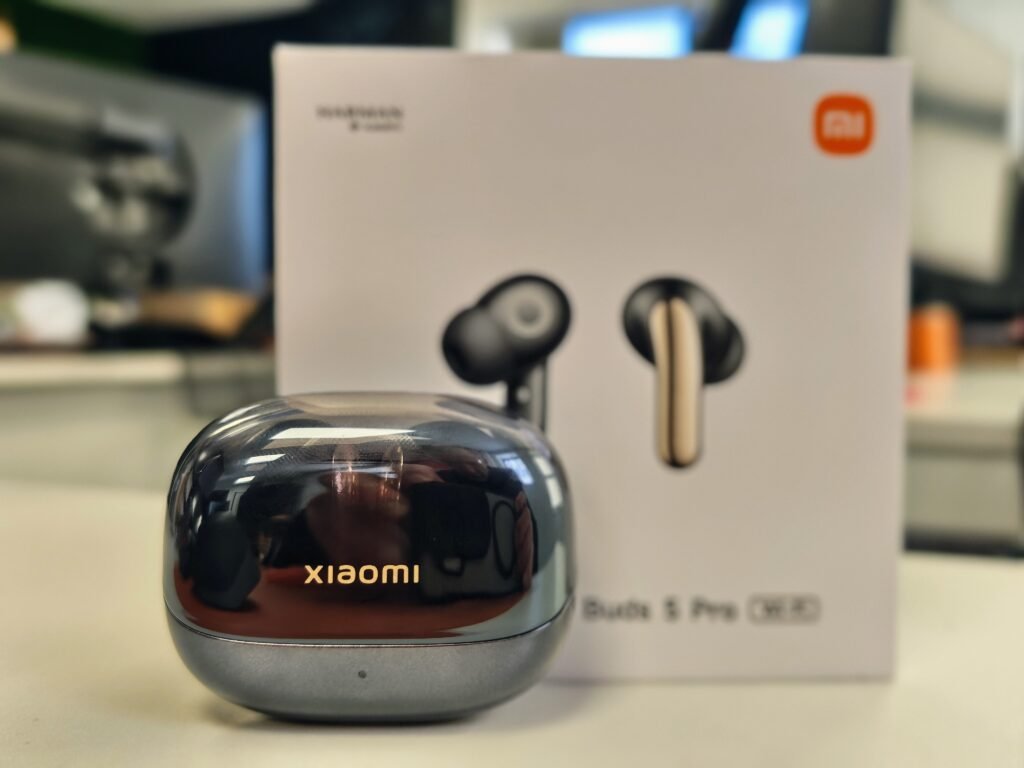
The Xiaomi Buds 5 Pro (Wi-Fi) earphones combine practicality and style with a translucent black color scheme that blends glossy and matte textures. They feature touch controls for music playback, calls, active noise cancellation, voice assistant, and recording, as well as touch controls for volume. The charging case offers up to 40 hours of battery life, and a quick charge provides 4 hours of playback in just 10 minutes, making these earphones ideal for everyday use in a variety of settings.
Xiaomi Buds 5 Pro WiFi vs. Xiaomi Buds 5 Pro
The main difference between the models is the presence of Wi-Fi modulation for higher-quality audio transmission: 4.2 Mbps versus 2.1 Mbps, which allows for streaming at 96 kHz/24 bit versus 48 kHz/24 bit.
Yes, the Wi-Fi version offers longer battery life (10 hours versus 8 hours) and comes in a variety of color options. The Wi-Fi model also features the Snapdragon Sound Technology Suite with Qualcomm XPAN technology for improved audio.
Interestingly, Xiaomi has integrated Bluetooth 6.0 into the Xiaomi 15 series, but both of these earphones still use Bluetooth 5.4.
96 kHz/24 bit vs. 48 kHz/24 bit
The main question is whether 96 kHz/24-bit is worth the extra cost over 48 kHz/24-bit. The reality is, the vast majority of people won't listen to music in a format high enough in quality to benefit from 96 kHz/24-bit.
Overall, 48 kHz adequately covers the range of human hearing (which typically extends to approximately 20 kHz). Some audio professionals report improved hearing when listening to 96 kHz recordings.
I would say that someone who likes 96kHz/24bit probably doesn't use wireless Bluetooth headphones at all.
To take full advantage of this, you need to play audio in the FLAC format. Previously, even Tidal couldn't provide this kind of audio quality, but after switching to HiRes FLAC, they now support resolutions up to 24-bit, 192 kHz.
Design

I received both the Wi-Fi model and the standard model. They have the same design, but the Wi-Fi model only comes in a translucent black case with black and silver earbuds. The standard model was white.

Overall, the design is a standard stem design similar to the AirPods Pro, Galaxy Buds 3, and many other earbuds.
A minor drawback is that the silicone ear tips use a non-standard-sized connector, which seems to be becoming increasingly common. Given Xiaomi's popularity, I expect replacement ear tips to be fairly easy to find.
Overall, the fit is good; the wide tips provide a secure fit that requires little adjustment, even during intense exercise.

Like most modern headphones, these are fairly easy to set up. They support pop-up and pairing, although the Xiaomi Ears app seems to require a factory reset and direct pairing.
Xiaomi Earbuds application and settings
The Xiaomi Earbuds app is well designed, easy to use, and has a wide range of features.
Functions:
- Battery charge level
- ANC Management
- Sound recording
- Gesture control
- Sound effects
- Spatial Audio
- Adaptive sound
- Adaptive volume
- Sound balance
- Additional settings
- In-ear detection
- earmold fit test
- Dual connection
- Receive calls automatically.
- Find your headphones
- Firmware update
Since I received my earbuds, they have received three firmware updates, so Xiaomi is quite actively working on improving their performance.
Sound quality
As with most modern headphones, you can customize the sound profile using the equalizer in the app.
The default setting is Harman AudioEFX, which provides a warm sound with a slight, but not overly, bass emphasis.
Then there's Harman Master, which seems to boost the bass a bit. Then there are the standard sound profiles, including bass reduction, treble boost, vocal enhancement, audiophile sound, or you can customize the equalizer to your taste.
I'm not much of an audiophile and prefer a warmer sound. This is especially true for sports, which is why I most often use in-ear headphones. My preference has always been either Harman AudioEFX or Harman Master.
I found that the combination of tuning and the triple-driver design allows these headphones to produce a pleasant level of bass without drowning out other frequencies. I'm very sensitive to high frequencies (thus preferring a warmer sound), and I found the highs to be well-balanced, matching my preferences. Detail is excellent, the mids don't overwhelm them, and there's no harshness or sibilance that some headphones are prone to.
Active noise cancellation
The claimed noise reduction is up to 55 dB, which I believe is the highest claimed figure of any headphone I've tested.
During a standard synthetic test using airplane cabin noise played through Edifier S3000 Pro speakers at 80% volume, the Buds 5 Pro earbuds effectively blocked out almost all low- and mid-frequency noise, leaving only the high-frequency hiss of the engine. Despite the excessively loud background noise, I was still able to enjoy music or watch media at a reasonable volume. This level of performance places them among the best earbuds in their price range.
They're perfect for everyday use, effectively blocking out annoying background noise whether you're in the office or out for a run.
There are a variety of active noise cancellation options, including adaptive noise cancellation, which adjusts the level based on your surroundings. There's also a transparency feature, allowing you to communicate with people or hear what's going on around you.
Battery life
Xiaomi claims the earbuds provide 10 hours of music playback, and the charging case adds another 30 hours when playing music at 50% volume and using AAC. I assume this is also without active noise cancellation enabled.
I didn't measure playback time, but the claimed 10 hours is in line with the OnePlus Buds Pro 3, and with active noise cancellation enabled, that drops to around 6 hours.
Using technologies such as aptX lossless will further reduce battery life.
Over the course of my use, I've used them for long workouts at the gym and long runs. I estimate I've used them for up to four hours at a time, and I've never had any issues with low battery warnings.
Call quality
Xiaomi's provided information doesn't mention anything about microphone setup or call quality, but from my limited testing, I found performance to be excellent.
Using a similar test as with active noise cancellation, I recorded a conversation against the background noise of an airplane cabin and was able to easily discern my voice up to 40% volume, which is quite a high background noise level. Once the volume reached 60%, my voice became difficult to discern at a normal volume.
General conclusion
Both versions of the Xiaomi Buds 5 Pro earphones are excellent, and Xiaomi deserves credit for pushing the boundaries of earphone technology.
Extensive codec support, including AptX Lossless, a triple-driver design and Harman AudioEFX Tuning technology ensure superior sound quality.
I was initially critical of the price, expecting a much higher starting price that would make it difficult to compete with other premium offerings. However, at £160/£190, I think the price is quite justified given the number of features and overall performance.
I like the idea of a Wi-Fi feature that can reach 4.2 Mbps throughput with a 96 kHz/24-bit sample rate, but I'm not sure it'll be of any real-world benefit. Many argue that 96 kHz/24-bit is useless, and even if it is, I doubt many will be able to fully utilize it in wireless headphones. I'm not sure the £30 price difference is worth it, but considering other options on the market, I don't think £190 is an exorbitant price.
Pros
- Excellent sound quality thanks to a three-speaker system and Harman tuning.
- High-resolution audio 96 kHz/24-bit over Wi-Fi with a data transfer rate of 4.2 Mbps.
- Effective active noise cancellation with noise reduction up to 55 dB
- Long battery life (10 hours on a single charge, 40 hours with charging case)
- Intelligent features such as translation, transcription and audio recording using artificial intelligence.
Cons
- The real benefit of using 96 kHz/24-bit audio format is unclear for most users.