

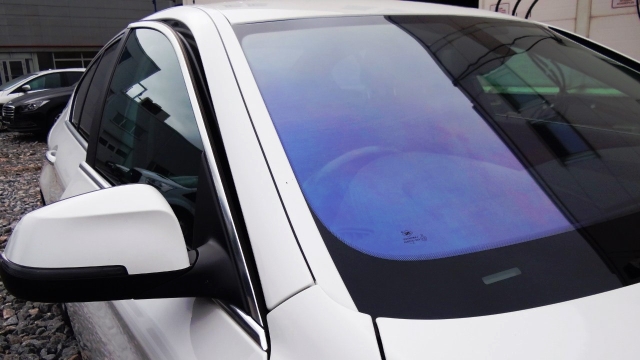
A windshield is more than just a piece of clear glass. It protects against wind, rain, and rocks, and even helps provide rigidity to the car's body. But what should you do if it gets a chip or crack? Can the damage be repaired, or will the entire windshield have to be replaced? Let's find out.
1. Types of damage: what can be repaired and what cannot
Not all windshield defects are created equal. Some are easily repaired, while others require complete replacement.
1.1. Chips (potholes)
They are caused by impacts of small rocks and appear as small craters with or without radial cracks.
✔ Can be repaired if:
- the diameter does not exceed 3 cm;
- no deep internal cracks;
- damage is not directly in front of the driver's eyes (this may distort the view).
✖ Replacement is required if:
- chip deep and affected the inner layer of glass;
- there are potholes all around long cracks;
- damage on the edge of the glass (reduces the strength of the structure).
1.2. Cracks
They come in different lengths and directions.
✔ Can be repaired if:
- crack short (up to 30 cm);
- she does not cross the entire width of the glass;
- damage didn't touch the edge (otherwise the glass loses strength).
✖ Replacement is required if:
- crack long and continues to grow;
- she forks or zigzags;
- damage is located in the wiper zone (constant pressure will accelerate destruction).
1.3. "Spiderweb" (multiple microcracks)
Usually appears due to sudden changes in temperature or a strong impact.
✖ Almost always requires replacement, because:
- the glass structure is damaged;
- repair will not restore transparency;
- strength reduced, there is a high risk of splitting during movement.
2. Repair technologies: how it works
If the damage can be repaired, use two main methods.
2.1. Filling with resin
Suitable for: chips and small cracks.
🔹 Detailed repair process:
-
Cleaning the damaged area
- A special solvent is used to remove dirt, oil and small fragments.
- If there is any debris left, the resin will not fill the defect completely.
-
Drying
- Compressed air or a vacuum unit is used.
- Moisture is unacceptable - otherwise the polymer will not stick.
-
Filling with resin
- They are introducing special optical polymer, close in refractive index to glass.
- They apply vacuum injector or pressure system, so that the resin penetrates into the smallest cracks.
-
UV lamp polymerization
- Under the influence of ultraviolet light the resin hardens 5-10 minutes.
- Without this step, the composition will remain liquid.
-
Grinding and polishing
- Remove excess resin.
- Restores the smoothness of the surface to eliminate glare.
✔ Advantages of the method:
- Fast (20–60 minutes depending on complexity).
- Cheaper than replacement (3-5 times more economical).
- The original glass is preserved (no risk of leaks after installing a new one).
✖ Disadvantages of the method:
- A trace may remain (especially if the damage was deep).
- Not suitable for complex cracks (if they diverge in different directions).
2.2. "Sewing" cracks
Suitable for: linear damage (for example, from a gravel strike).
🔹 Detailed repair process:
-
Marking and drilling
- The cracks are drilled along the edges micro holes (0.5–1 mm).
- This stops further damage from growing.
-
Polymer filling
- They pour into the holes special resin, which penetrates the crack.
- They use applicator needle for precise application.
-
UV drying and polishing
- After hardening the surface polished until transparent.
- If everything is done correctly, the crack becomes almost invisible.
✔ Advantages of the method:
- Stops crack growth (if done on time).
- Restores glass strength up to 90%.
✖ Disadvantages of the method:
- A noticeable trace (if the crack was wide).
- Not always suitable for long damages (over 30 cm).
3. When is it better not to save money and replace the glass immediately?
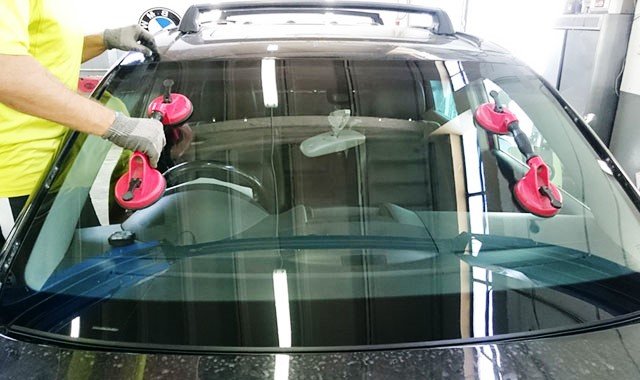
Sometimes repairs are temporary solution, and after a few months the problem returns. Replacement is inevitable if:
🔴 Damage on the edge - violated structural integrity, the glass may break due to vibration.
🔴 The crack was in the driver's field of vision - even a slight distortion dangerous while moving.
🔴 The glass has been repaired before. - repeated interventions reduce strength.
🔴 There is a risk of splitting due to vibration - for example, when driving frequently bad roads.
4. How to extend the life of a windshield after repair?
Even successfully repaired glass requires careful handling.
✅ Avoid sudden temperature changes
- Don't turn it on turn the stove to maximum in winter, if the glass is cold.
- Do not direct in summer air conditioner directly onto the glass.
✅ Avoid mechanical stress
- Doors slamming, pressure on the roof can cause new cracks.
- Be careful with car washes – a strong jet of water can worsen the condition of the repair area.
✅ Wash carefully
- Don't rub with hard brushes in the repair area.
- Better to use soft lips и special means for glass.
✅ Monitor the condition
- If there is a crack began to grow, contact the service immediately.
- Once every six months check repair area for resin delamination.

5. Conclusion: repair or replacement?
The decision depends on type of damage, its location and your plans for the car.
🟢 Repair - if there is a defect small и does not obstruct the view.
🔴 Replacement - If the risks are too high (the crack grows, the glass loses strength).
The main thing is not to ignore the problem. Even a small chip can turn into a huge crack over time, especially if temperature changes or vibrations. It's better to resolve the issue now than later. urgently change the glass on the road.
Have you had any experience with windshield repair? Share your experiences in the comments!