

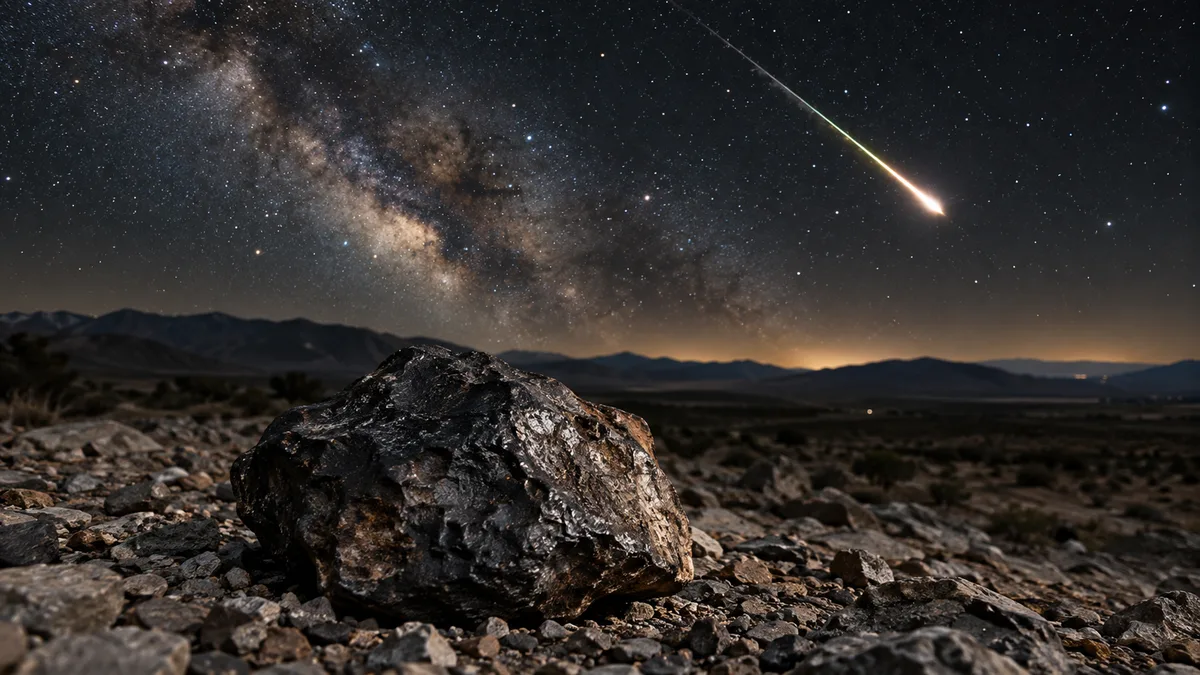
A meteor is a luminous phenomenon—a streak of light in the sky—that we see when a piece of space rock enters the atmosphere and burns up. A meteorite is a physical fragment of this body that survives passage through the atmosphere and falls to the Earth's surface. Therefore, a meteor cannot be picked up from the ground, while a meteorite can be held in the hand. Both concepts are related by a third term—meteoroid, or the object itself, orbiting in space.
To sum it up
- Meteoroid – a small rocky or metallic body in interplanetary space.
- Meteor — a luminous trail in the atmosphere, colloquially called a "shooting star"; it is a phenomenon, not an object.
- Meteorite — the remnant of a meteoroid that reached the Earth's surface.
- In the vast majority of cases, meteors do not form meteorites – the smallest fragments completely evaporate in the atmosphere.
Meteoroid, meteor, meteorite – three stages of one path.
The easiest way to remember the difference is to think of the three words as successive stages in a journey of the same particle. While it's moving through space, it's a meteoroid. When it enters Earth's atmosphere and begins to glow, we observe a meteor. If any part of it reaches the ground, we call that fragment a meteorite.
International Astronomical Union (IAU) adopted definitions of meteorological terms. They define a meteoroid as a naturally occurring solid body, approximately 30 micrometers to 1 meter in size, moving through or originating from interplanetary space. These boundaries are arbitrary. Larger objects are called asteroids, and even smaller particles are called interplanetary dust.
What is a meteor?
Meteor is luminous phenomenon , not an object. The meteoroid enters the atmosphere at high speed, quickly heats up upon collision with air molecules, and evaporates. The heated material and the ionized air around it glow—hence the short-lived glow we colloquially call shooting star . This, of course, has nothing to do with the stars.
Particularly bright meteors have their own names. According to the International Astronomical Union (IAU), a meteor brighter than magnitude -4 (roughly brighter than Venus) is bolide , also known as a bolide. Bolides are more likely to leave behind meteorites than regular meteors because they are formed by larger objects.
As the Earth passes through the debris stream left behind by a comet, we observe meteor showers — for example, the Perseids in August or the Geminids in December. At the peak of a meteor shower, there can be significantly more meteors than on a normal night.
What is a meteorite?
Meteorite is a solid body that has survived passage through the atmosphere and lying on the Earth's surface. Typically, it has a dark, thin crust formed during its passage through the atmosphere, and its internal structure consists of a material completely different from typical terrestrial rocks. Meteorites are named according to the place where they fell or were discovered. Researchers distinguish between «"falls »" - meteorites whose passage was noticed and collected shortly thereafter, - and «"finds"» — specimens discovered by chance, often many years after a fall. "Falls" are more valuable scientifically because they were exposed to moisture and air for a shorter period of time.
Depending on their composition, three main groups can be distinguished:
- Stony meteorites – consist mainly of silicates; are divided into chondrites (with characteristic spherical grains – chondrules) and achondrites.
- Iron meteorites – consist mainly of an alloy of iron and nickel.
- Stony-iron meteorites – a mixture of metal and silicates (for example, pallasites and mesosiderites).
Meteorites are invaluable to scientists because they allow them to study material from asteroids, and in rare cases even from the Moon or Mars, without sending probes there.
Meteor and meteorite - comparison table
| Characteristic | Meteoroid | Meteor | Meteorite |
|---|---|---|---|
| What's happened | An object in space | Light phenomenon | Object on Earth |
| Where does this happen? | Interplanetary space | Earth's atmosphere | The surface of the Earth |
| Can you touch it? | No (he's in space) | No, it's about the light. | Yes |
| Size | A commonly used range is approximately 30 µm – 1 m (IAU). | Not applicable - this is an easy path. | From the smallest crumbs to multi-ton blocks |
| Common name | Flaw | Shooting star; bright - fireball | «Stone from Heaven» |
| How to study it | Orbital observations and models | CCTV cameras and networks | Laboratory analysis |
Meteorites in Poland
Several world-famous meteorites have been found in Poland:
- Morasco (today a district of Poznań) – iron meteorites discovered since 1914; the area contains small impact craters protected as a nature reserve.
- Pultusk – On January 30, 1868, one of the most famous meteorite streams, consisting of stony meteorites, fell here.
- Lovich – a meteor shower of iron stones observed on the night of March 11–12, 1935.
- Baskovka Near Warsaw – a stony meteorite that fell on August 25, 1994; known for its oriented cone-shaped form.
How to distinguish a meteor from a meteorite?
If you see a short strip of light , A meteor that disappears within a fraction of a second or a few seconds is a meteor. They are best observed away from city lights, after your eyes have adjusted to the darkness, and ideally during a known meteor shower.
A meteorite is identified by its physical characteristics. These characteristics can be useful:
- dark, matte on the surface melting crust .
- large mass relative to size,
- magnetic attraction – most meteorites contain metallic iron.
- Absence of bubbles characteristic of slag and volcanic rocks.
None of these characteristics are definitive—many surface finds (slag, iron ore, magnetite) look identical. Only laboratory testing, for example, at a geological museum or university, can provide a definitive assessment.
Frequently Asked Questions (FAQ)
What is the difference between a meteor and a meteorite?
A meteor is a glowing trail in the sky formed when a cosmic particle burns up in the atmosphere. A meteorite is a physical fragment of such a particle that survives passage through the atmosphere and falls to Earth.
What is a meteoroid?
It is a small, solid body moving through interplanetary space. According to the International Astronomical Union (IAU), its diameter typically ranges from 30 micrometers to 1 meter. Upon entering the atmosphere, it forms a meteor.
Does every meteor turn into a meteorite?
No. The vast majority of meteors are very small particles that completely evaporate in the atmosphere. Meteorites leave behind mostly larger objects, which are often observed as bright fireballs.
What is a bolide?
A bolide is a very bright meteor, defined by the International Astronomical Union (IAU) as brighter than magnitude -4, or about brighter than the planet Venus.
In which region of Poland did the meteorites fall?
The most famous meteorites are Morasko near Poznań (iron meteorites and craters), Pułtusk (meteor shower of 1868), Łowicz (1935) and Baszkowka near Warsaw (1994).
See also
- What is the difference between weight and mass?
- What is the difference between an island and a continent?
- What is the difference between a telescope and a regular telescope?
- What is the difference between a physical phenomenon and a chemical reaction?