

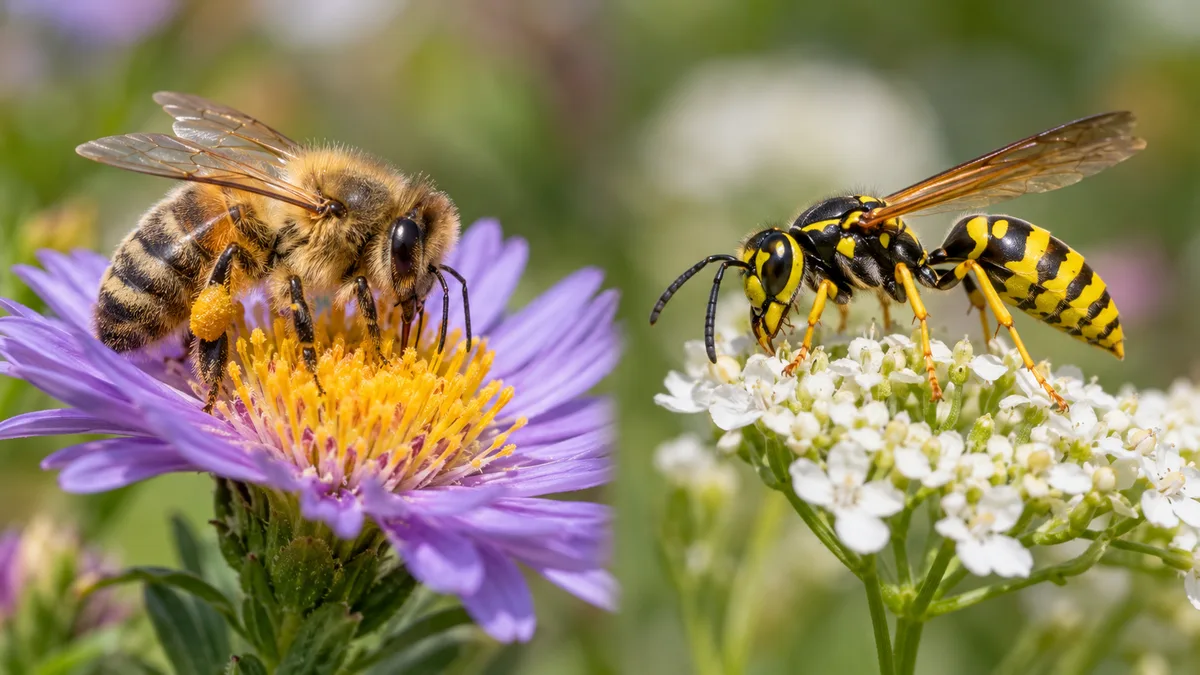
A bee differs from a wasp primarily in its appearance and lifestyle: a honey bee has a stocky, hairy, brown-golden body and feeds on nectar and pollen, while a wasp is slender, smooth, bright yellow-black, with a characteristic "wasp waist" and hunts other insects. Their stings also differ: a bee typically leaves its sting in human skin, while a wasp can sting multiple times. Both species belong to the Hymenoptera family, so they are easily confused.
To sum it up
- Appearance: The bee is hairy, matte, brownish-golden in color; the wasp is smooth, shiny, with contrasting yellow and black stripes.
- Bite: A bee has a barbed stinger that remains in the skin; a wasp has a smooth stinger and can sting multiple times.
- Nutrition: Bees feed on nectar and pollen; adult wasps eat sweet juices and fruits, and larvae feed on insects.
- Nest: Bees build wax honeycombs, wasps build papier-mâché nests, which are emptied in the fall.
How to recognize a bee and a wasp by appearance?
The easiest way to tell them apart is by looking at their bodies. Honey bee The bee is stocky and covered in dense hairs, giving it a fluffy and dull appearance. Its coloration is subdued—brown, golden, and dark stripes, without bright yellow hues. The hairs are not decorative: they hold the pollen that the bee collects and carries back to the hive, and small pollen clumps, known as pollen sacs, are often visible on its hind legs.
Wasp (in our country, most often the common wasp or German wasp) has a thin, smooth, and shiny body. Its coloration is contrasting: rich yellow and black stripes serve as a warning signal. There is a distinct narrowing between the thorax and abdomen—hence the name "« wasp waist »"Pollen balls are not visible on the wasp's body because it does not collect them.
Bee and wasp stings – what’s the difference between them?
There is a sting on the surface of a bee's sting jags . Once a bee penetrates human skin, it can't remove it—it breaks off along with the venom gland, and the insect usually dies. Therefore, after a bee sting, the stinger is most often visible on the skin.
Wasp sting smooth . The wasp easily removes it and can sting again. Nothing remains in the skin, making it easy to identify the culprit: if you see a stinger, it was almost certainly a bee.
A bee sting should be removed quickly by gently peeling it off, for example, with a fingernail or the edge of a card. Avoid squeezing the sting with your fingers, as this could cause additional venom to be released from the gland. This is usually accompanied by pain, redness, and swelling. However, if you experience shortness of breath, swelling of the face or throat, hives all over the body, dizziness, or the sting affects the mouth or neck, you should call 911 immediately. number 112. People with allergies to insect venom should consult an allergist.
Comparison Chart: Bee or Wasp
| Characteristic | Honey bee | Wasp |
|---|---|---|
| Physique | Stocky, hairy, and rather blunt | Slim, smooth, shiny, with a waist« |
| Coloring | Brownish-golden, muted | Bright yellow and black stripes |
| Sting | If burdock is present, it remains in the skin. | Soft bite, possibly multiple stings. |
| Food for adults | Nectar, pollen, honey | Sweet plant juices, fruits, nectar |
| food for larvae | Milk, then pollen and honey | Insects and spiders that were hunted |
| Nest | Wax patches | Paper pulp made from shredded wood. |
| Winter | The family survives the winter in a close-knit group. | The nest dies, and the young queens hibernate. |
| Products | Honey, wax, propolis | No consumables |
Food, nest and family life
Honey bees live in colonies consisting of queen bee, worker bees and drones . They build vertical honeycombs from wax they produce themselves. These hexagonal cells are used to raise brood and store honey and pollen. The bee colony does not disperse in the fall; it overwinters in a compact cluster, keeping each other warm and sharing supplies.
Wasps build nests from papier-mâché — crushed wood fibers mixed with saliva. They build them in tree hollows, under roofs, in building crevices, or in the ground. Adult wasps require sweet food, and the larvae feed on insects such as flies and aphids. At the end of the season, the colony dies, and only the fertilized young queens survive the winter, building new nests in the spring. The old nest is not repopulated.
Is a wasp more dangerous than a bee? Its behavior and role in nature.
Bees rarely attack outside the hive—they hunt flowers and sting mainly to defend themselves or the nest. Wasps most often circle around people, seeking sweet drinks, fruits, and meat in late summer. It is at this time that they seem most persistent, although they most often sting when disturbed, startled, or while defending the nest.
Both groups are necessary. Bees are one of the most important pollinators plants, including agricultural crops. Wasps also visit flowers, but their main role is in regulating the numbers of other insects – wasp larvae eat numerous flies, aphids and caterpillars.
There are also cases of confusion with other insects. Bumblebees much larger and fluffier than honey bees, and hornets They are noticeably larger than wasps and have a reddish-brown coloration. Some flies (such as hoverflies) mimic the coloring of wasps, although they lack a stinger—they can be recognized by their single pair of wings and large eyes.
How to behave in the presence of a bee or wasp?
- Don't wave your arms – the insect perceives sudden movements as an attack.
- Cover sweet drinks outdoors and drink through a straw - wasp in a jar is a common cause of mouth stings.
- Do not approach the nest. and do not attempt to remove it yourself; if you find a wasp nest in your home, contact the appropriate company or fire department.
- Walking barefoot on the grass overgrown with flowering clover, It's easy to step on a bee - better to wear shoes.
- If you have allergies , carry the medications prescribed by your doctor with you.
Frequently Asked Questions (FAQ)
How to distinguish a bee from a wasp?
The bee is stocky, hairy, and has a dull brownish-gold coloration. The wasp is slender, smooth, and bright yellow-black, with a distinct narrowing between the thorax and abdomen.
Does a bee die after stinging?
A worker bee usually dies after stinging a person because its barbed stinger becomes embedded in the skin and detaches from the body. A wasp, however, has a smooth stinger and can sting multiple times.
Do wasps produce honey?
No. Bees produce honey, wax, and propolis. Wasps build nests from paper pulp and don't store provisions for the winter.
What hurts more - a bee sting or a wasp sting?
The sensation varies depending on the location of the bite, the body's sensitivity, and other factors. More important than pain are the general symptoms—shortness of breath, facial swelling, or hives all over the body—which require immediate medical attention (112).
What is the difference between a wasp and a hornet?
The European hornet is a relative of the wasp, but significantly larger. It also has a distinctive coloration, featuring reddish-brown elements instead of just yellow and black.
See also
- What is the difference between an insect pupa and a larva?
- What is the difference between a hare and a rabbit?
- What is the difference between a marten and a weasel?
- What is the difference between a llama and an alpaca?