

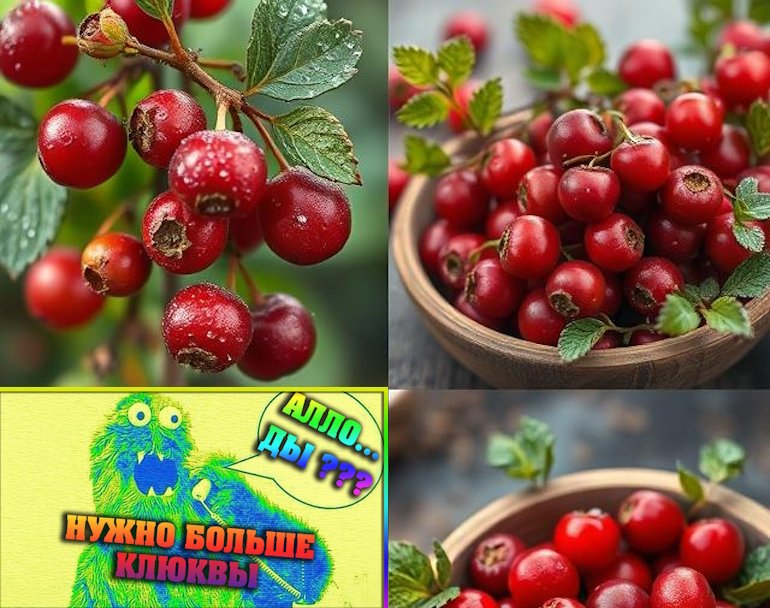
Cranberry — is a polysemantic word that has several interpretations in Russian.
Description: What is cranberry and what are its meanings? From its botanical description and benefits to its figurative meanings in culture and language. We explore all the meanings of the word.
The primary meaning is associated with the plant and its fruits, but in modern language the word “cranberry” has also acquired a figurative meaning, especially in a cultural context.
Botanical description and origin
Cranberry is a small, creeping shrub in the lingonberry family that grows abundantly in mossy bogs and produces juicy, tart red berries rich in citric acid. The word “cranberry” is of Slavic origin, but its exact etymology remains unclear. Some researchers link it to the Bulgarian word “klyuvka,” which may suggest a connection with birds, such as cranes, that feed on these berries. In other Slavic languages, such as Belarusian and Ukrainian, cranberry is called “zhuravlina,” further supporting this connection.
Cranberries are rich in various beneficial substances. They contain sugars, organic acids (primarily citric acid), pectin, and vitamins. Cranberries are a valuable source of vitamin C, comparable to oranges and lemons. They also contain vitamins B1, B2, B5, B6, PP, and K1. Thanks to this composition, cranberries are widely used in cooking for making fruit drinks, sauces, and desserts, as well as in medicine as a preventative and treatment for colds.
Figurative meaning in cultural context
The figurative meaning of the word “cranberry” arose as a metaphor reflecting the stereotypical portrayal of Russia in foreign media. This concept has become entrenched in colloquial speech and has become a symbol of clichéd notions of Russian culture.
In such images, Russia is often portrayed as a land of endless snowy expanses, where bears roam the streets and residents drink vodka everywhere. These are blatant clichés, far removed from the country's diverse reality.
Foreign films and books often portray Russia as a cold, harsh place where everything is subject to the laws of nature and survival, which reinforces the stereotypical effect. Images created in this way give viewers and readers a simplified understanding of Russian reality.
This figurative use of the word “cranberry” becomes a means of criticism and irony toward external perceptions of Russia. It highlights the inadequacy and inconsistency of these images with contemporary Russian society.
The term is often used in discussions when it comes to artistic or journalistic works that portray Russia through the prism of stereotypes rather than reflecting its real social and cultural characteristics.
As a result, the word “klankva” acquired a symbolic meaning, serving as a mockery of simplistic and outdated notions of the country. It became a tool for self-criticism and reflection on cultural phenomena associated with Russia's image abroad.
Some critics argue that the use of this term undermines an objective perception of Russian reality, obscuring the country's real problems and achievements under a layer of irony. Others see it as an opportunity to draw attention to the imbalance between stereotypes and reality.
The word “cranberry” is also part of some phraseological units and set expressions in the Russian language:
For example, the expression “spreading cranberries” is used to describe something absurdly implausible. Furthermore, the exclamation “Well, that's a real surprise!” expresses surprise at some unpleasant unexpected event.
Conclusion
The word “klankva” (cranberry) in Russian has a rich palette of meanings and nuances. From denoting a specific plant and its fruit to reflecting cultural phenomena and stereotypes, “klankva” exemplifies how language adapts and responds to changes in society and culture.