

Some days, language can be incredibly slippery. We can play fast and loose with the rules of language and grammar to the point that words can end up meaning completely different things over time, like how literally "something" gradually came to mean the exact opposite. We also regularly invent new words as needed. Sometimes we say things that don't mean what we thought they did. There are more than a few commonly used words and terms that most of us take for granted, but which aren't actually what we think they are.
10. A nutritionist is not a real thing

Chances are you've read a news article or seen a segment on a show where a nutritionist quotes something health-related. Whether it's something nutritionistswould have ordered in a fast food restaurant, or foods that nutritionists say you should should never eat , they get a lot of media coverage, sharing their expertise on which foods are good for you and which ones to avoid.
The irony of a nutritionist sharing his experience is that he may actually have nothing. In the US and Canada The term "dietitian" is virtually unregulated and doesn't mean anything specific. A dietitian must be trained and certified in their field and genuinely help treat illnesses through dietary management. However, anyone can call yourself a nutritionist and recommend any diet. There are organizations that can certify dietitians, but this requirement is by no means legal nationwide. So, unless you check someone's credentials, those claiming to be dietitians could just as easily be bloggers with a passion for food as someone trained to understand nutrition and diet.
9. Curry means nothing
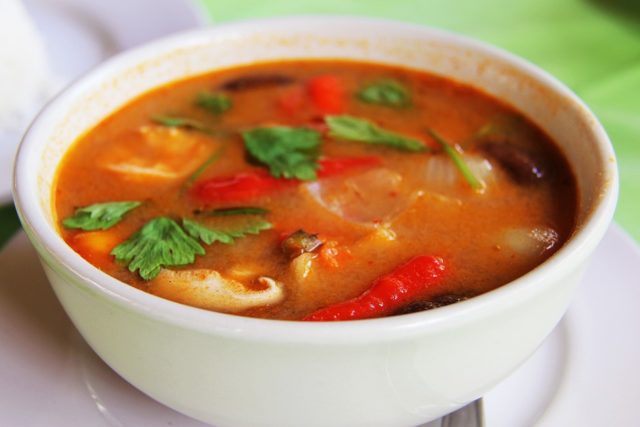
The most famous dish in all of Indian cuisine, there are probably few who haven't tried curry or at least don't know what it is. You can get a multitude of heat levels and a nearly endless number of ingredients in any given curry, from goat to lamb, vegetables, and beyond. But what you might not know is that the word "curry" has a very loose definition, and what we call curry in the Western world doesn't actually represent the true meaning of the word.
Let's start with the fact that we typically refer to curry as two different things. One is "curry," which is the actual dish itself, and the other is curry in the form of a spice, the yellow powder most often associated with Indian food. But there are many types of curries and sauces, and the closest definition of what curry is might be the method of preparation using a spicy sauce. sauce . But even that's not entirely accurate, because, as we saw with the spice example, it shouldn't refer to a sauce at all, even though that's what most people mean. So why use the word at all, and where did it come from?
In many ways, the word "curry" is a product of colonial thinking. Everything fell under the banner of curry because for these people it was alien and unusual, and it was a quick, lazy way to categorize everything. Call it curry and be done with it. So, while we technically think of curry today as a dish with a sauce or spice, the fact that it can be applied to many dishes shows that this definition was never truly clear.
8. Kung Fu can apply to anything you practice

Back in the 1970s, there was a kung fu fever in America. TV show «Kung Fu» debuted in 1972, inexplicably starring David Carradine as a Shaolin monk, and a year later the legendary «Enter the Dragon» Bruce Lee. Both of them cemented kung fu as a popular action film subgenre that still survives in the West today thanks to films such as «Kung Fu Panda» .
While it may seem obvious that kung fu is a martial art like karate and taekwondo, and the characters in these films become kung fu masters, in the end, that's not entirely true. Kung fu, or gong fu, means "« acquired skill »" This refers to study and practice a craft you can master through hard work. The martial art most people refer to is probably Wu Shu.
A person who trains and masters martial arts is an absolute kung fu master. But a person who trains to master basketball is also a kung fu master. So is an artist, a doctor, or a gamer. If you dedicate yourself to being the best you can be, you've largely achieved your goal.
7. The quality of sushi or the quality of sashimi means nothing

People love sushi and sashimi, and in America the industry is worth 22 billion dollars , which is a multitude of tiny rolls. But you can't just make sushi out of any old thing; creating it properly requires a lot of skill. The right type of rice, the right combination of other ingredients, and, of course, sushi-grade fish. Or maybe not.
It turns out that "sushi class" is more of a marketing term , than one that has some specific meaning. Simply put, if something is labeled "sushi grade," it means you can eat it raw . It doesn't reflect the quality or freshness of any particular fish at all, nor does it indicate that it's of higher quality than any fish that doesn't bear such a label. Therefore, frozen fish can easily qualify as sushi grade. If it's edible and meets the parasite-free guarantee established by the USDA and the FDA, it's sushi grade.
The parasite-free guarantee requires that raw food be handled in a manner that kills any parasites. All raw fish except tuna must be handled this way. The fish must be stored at -20°C (-4°F) for 7 days or -35°C (-22°F) until firm, then for 15 hours, which is sufficient to kill parasites. If you do this, your fish will pass the test and can be sold and consumed raw in the United States.
6. Ketchup is not a tomato sauce.

According to statistics, the average American consumes 5.2 liters ketchup per year. That seems like a respectable amount, and when you say it, everyone knows what you mean. Ketchup is a standard in the fast-food hamburger world, and it's also often served with fries and hot dogs. It's a sweet tomato sauce that Heinz sells. 650 million bottles every year.
While ketchup means tomato sauce to almost everyone today, there's nothing in the definition of what ketchup is that requires it. Tomato ketchup is just one type of ketchup, but you can trace the condiment back to 300 BCE, while the tomato version hasn't appeared yet. until 1812 .
Old-school ketchup originated in China, and its original recipes used fish guts and soybeans. You can still find it in the UK. mushroom ketchup or just find a recipe online and make your own.
The name comes from ge-thcup or koe-cheup and spread from China via trade routes, allowing people in other countries to adapt the recipe to local ingredients. Older versions included not only fish and mushrooms but also nuts, celery, and fruit.
5. Guide dogs are not just guide dogs

Technological advances continue to make the world a more accessible place for people with disabilities, but one of the most easily recognizable aids available to blind or visually impaired people is a guide dog. Guide dogs can be an invaluable companion for many people with visual impairments. However, the language used to describe them can be a bit confusing.
All guide dogs are seeing-eye dogs, but not all seeing-eye dogs are seeing-eye dogs. Although it's not widely known among those who don't require their services, "seeing-eye" is the name of an organization that trains certain dogs to be seeing-eye dogs, and it's the oldest organization in the world that does this. Only dogs trained using their process are properly called guide dogs , this name is a registered trademark. They breed their own dogs for work, and only qualified trainers hire them to train them for work. However, there are many other dog training organizations, and their dogs are referred to by the more general term "guide dog.".
4. Baby aspirin is not intended for children.

Chalk this misunderstanding up to poor planning and poor word choice, but baby aspirin is not intended for infants. Properly known as low-dose aspirin , It refers to a pill that simply contains less of the active ingredient. For a long time, the medication was called "baby" because it's a small dose, almost like we think of baby carrots or baby steps, when we simply mean small. The problem is that people started taking this literally.
In fact, children can have very adverse reaction Aspirin sensitivity, known as Reye's syndrome, can occur. This is rare, but it does happen, so it should only be given under a doctor's advice.
3. Bollywood does not refer to all Indian cinema

Hollywood dominates filmmaking so much that everyone knows exactly what you mean when you talk about Hollywood. Movies can be made anywhere and still be called Hollywood. Unless, of course, they're Bollywood.
For most Westerners, Bollywood refers to Indian films. This can also include the stereotype of a lot of singing and dancing. But that's far from the whole story. Let's start with the fact that Bollywood cinema is Indian cinema, but Indian cinema isn't necessarily Bollywood. Bollywood is a combination of Hollywood and Bombay, not known as Mumbai. In this region he produces Hindi language films . This is one of many "forests"« , which currently exist in India and Pakistan.
Pollywood is a term that refers to the Punjabi film industry, Lollywood refers to Pakistani films made in Lahore, and there is also Chollywood, Ollywood, Kollywood, Tollywood, Mollywood, Dhaliwood and maybe a dozen more.
2. Technically, death by electrocution refers only to death by electricity.

If you were wiring your home and accidentally touched a live wire that gave you an electric shock, would you say you were electrocuted? These days, that's the standard term almost everyone uses when talking about electric shock. You'll see it on safety signs and even on government websites. Strictly speaking, this word refers to death by electricity , and not just from electric shocks. It's a combination of "electricity" and "execution," and it was coined shortly before the first execution by electric chair, during the lurid furor over the battle between alternating current and direct current, when Thomas Edison publicly electrocuted animals to prove that direct current was safer.
However, the word quickly came into common use because as electricity spread among ordinary people, anyone who suffered from non-fatal electric shocks, A word was needed to describe their experience, and "electrocution" was there.
1. Military rank means nothing.

Much like "sushi grade" is a marketing term, when you see something advertised as military-grade, there's a good chance it doesn't mean anything either. The company using the term clearly wants you to think the product is durable and long-lasting, perhaps stronger than similar products, and capable of withstanding a war zone, but that's not the case.
Even military-approved products don't actually have to meet a lot of strict rules , when it comes to how they're made, so a company that doesn't work for the military is unlikely to push the boundaries here. Military standards were intended only to provide cheap and effective products that worked but didn't cost a fortune.