
Ireland has a rich tradition of strange and wonderful creatures, but it's not just fairies and leprechauns. Some denizens of the Irish underworld are truly terrifying. Like these 10!
10. Abhartakh
Long before Irish writer Bram Stoker Invented Dracula, in Ireland there was a bloodsucker named Abhartach. One day, an evil wizard-king from the hills around Glenullin, dwarf Abhartakh , was killed by his subjects and buried standing. When he returned the next day, demanding blood from their veins, his terrified subjects killed him again. But it was no use. Abhartakh kept coming back.
In desperation, they sought out a hermit in the forest and asked him what they should do. «Abhartakh is not really alive,« he explained, “he is one of neimkh-mkhayrbkh [«undead»].» In other words, he couldn't be killed. But he could be «hung» if killed with a yew sword and buried upside down in the ground, covered with ash branches and thorns, under a very large stone. Abhartach would remain there as long as the stone lasted, the hermit said.
The stone stands there to this day, with a tree growing from the thorns. Even now, it's considered «bad soil.» Tragically, the most recent attempt to clear it—in 1997—was thwarted by a faulty chainsaw and bloodshed when the chain lifting the stone snapped and cut one of the workers.
9. Banshee
Perhaps the most famous ghoul of the Emerald Isle is the banshee, which in Irish ( bean sí ) means «woman from the other world.». Her screams and cries, heard at night, foretell death in the family, but only if your family is Irish . Irish poet W. B. Yeats described the banshee as «the fairy's assistant who follows old families and only them.» More than one is considered an honor.
Queen banshee , Cliodhna was a goddess of love and beauty, accompanied by birds that healed illnesses. But she also lured sailors to their deaths. For this, she was punished by the sea god Mananan Maclir. When she left the Otherworld to be with her mortal lover, Maclir drowned her with a wave. Hence the legend in Glandore, County Cork, that the loud wave belongs to Cliodhna.
8. Banana
Bananas ( bánánaigh ) - a type of screaming female ghost, attracted by force , to circle the skies above battlefields. They are somewhat similar to banshees, and their name may have a similar root. If not only from bán , meaning «white» or «pale,» bánánach may come from bean / ban , which means «woman».
In early Irish texts they usually appear together with their male counterparts, the bocanach ( bocánaigh ). These «demons of the air,» as the monastic scholars called them, actively encouraged the bloodshed of war. Judging by their name, which comes from bocán (meaning «goat»), it is suggested that they had an appearance similar to Puck.
7. Fomorians

In Irish mythology there are basically two main factions: one good, the Tuetha De Danann, and one evil: Fomorians or Fomorians. The name is believed to come from fó , meaning «from below,» and a suffix meaning «sea,» «demons,» or «giants.».
The Fomorians are said to have built megalithic monuments in Ireland. The Fomorians are said to have been the first settlers of Ireland, numbering 200 men and 600 women. But their predominant characteristic is mutant appearance , which they themselves consider a blessing from the dark gods. Mismatched limbs, animal heads, too many eyes, etc. are common. They also possess ancient earthly magic— «by the power of the serpent» — and control the weather and the plague.
Their king, Balor of the Evil Eye, had a burning eye so enormous that four men could lift it. With it, he could reduce a man to ashes and devastate entire regions, as he did to the islands west of Scotland. In fact, it was so dangerous that he always wore seven cloaks over it and never gave it to his men. Whenever the time came to use it against an enemy, the cloaks were torn off one by one—the first removing a withering fern, the second removing brown grass, the third heating the trees, and so on, until the sixth was removed, and the second set the very earth ablaze.
6. Fear of the throat
Gorta fear , or «hungry man», wanders Ireland during times of famine, begging from house to house for food. Its ancient origins are obscure. According to some, it rises from the «hunger grass» (or féár gortach ), which curses anyone who steps on it to die of starvation. Others say the mountain of fear is the ghost of a man who died of starvation near the fairy hill.
Whatever his origin, the unfortunate throat of fear appears emaciated, dressed in rags, with long, dirty fingernails and carrying (often dropping) a begging bowl. Unlike hungry grass, which can be burned, throat of fear impossible to destroy . However, there is a way to protect oneself: compassion. Those who feed him with what they can are thanked or rewarded for service , while those who do not, especially if they mock (or, worse, attack) him, are doomed to failure and starvation.
That's why they say the pit of fear has turned kings into beggars and beggars into princes. However, it is always a sign of difficult times to come.
5. Extraction
Attraction (comes from Old Irish faíth , (meaning seer) is Ireland's answer to its double. Depending on whether you see it in the morning or evening, it can bring good or bad luck. But generally, choice is bad.
Taking the form of a person whose death is imminent, this shape-shifting spirit is either them or their immediate omens. What distinguishes it from a regular doppelganger is its tendency to hint at the cause of impending death—showing burns if it's a fire, clutching its chest in a heart attack, etc. It also lacks shadows . Needless to say, all of this makes the choice more terrifying.
Afetch could appear even after death, walking among loved ones. at the funeral with a distant expression on his face. Apparently, if you follow him for a while, he will disappear into a dark corner or hide behind a tree.
4. Sluagh
The sluagh are monsters with a taste for human souls, especially those in true love. According to the ancients, sluagh are fairies, «gone wild», « distorted and perverted , without fear, reason, or mercy.» Later, Christians explained them as the souls of sinners, doomed to wander the earth, dragging souls to Hell with them. They are said to be especially active on Halloween, when all bonfires were traditionally banned to avoid attracting their attention. But no matter what day of the year it is, there is an old Irish tradition of keeping west-facing windows tightly closed to keep the slugs at bay. (They were said to fly from the west after sunset.)
Sluagh also capture mortals as slaves, commanding them to do their bidding. For example, if a sluagh is denied the soul they crave, they will force their slaves to slaughter cattle, sheep, and livestock. This is because the sluagh themselves have no corporeal presence, typically manifesting as a rippling shadow resembling a large flock of ravens. In fact, the word sluagh means «master».
The sluagh were so feared in the old days that people preferred death to their fate.
3. Dobhar-chu
Otters—the way they hold hands, the pouch they carry their belongings in, their fluffiness, and so on—are impossible not to feel good about. They're essentially the penguins of the Northern Hemisphere; you can't help but smile when you see them. But trust Ireland to make them scary.
Dobhar-chu is a kind of otter from hell, a vampire with «giant fangs.». It was first encountered on the shores of Glenade Lake in County Leitrim, fast asleep on the bloody body of one Grace Connolly. Upon seeing the creature, her husband, Terence McLaughlin, ran home, grabbed a pistol, returned, and shot the creature, which emitted a terrifying scream, like a death rattle. In response, another Dobhar-Chu emerged from the lake, and this man was forced to kill it. Eerily, both Connolly and McLaughlin have depictions of these creatures on their tombstones.
However, these weren't the only sightings. Dobhar-chu, or the «Irish crocodile,» as it's sometimes called, was allegedly fighting with others. It was also seen and photographed as recently as 2000. According to photographer Sean Corcoran, who spotted the creature on Omey Island, Connemara, it swam across the lake in seconds, leaped onto a boulder, and let out «the most haunting screech.» .
2. Ollifeistanna
We've all heard of St. Patrick driving snakes out of Ireland, but what does the old legend mean? Well, scientists aren't entirely sure, but it may have something to do with a breed of giant, worm-like monsters. Like dragons , olliphéisteanna (singular, olliphéist : from oll , «great» and péist , «worm», «beast», «reptile») are so massive that their snakes carve rivers into the landscape. They say that thus formed River Shannon , left behind after the Olipheist fled from St. Patrick.
Otherwise, they are said to lie in wait in deep lakes, underground caves, and especially in swamps and marshes. Even their blood is toxic. Therefore, when the healer of the gods, Dian Cecht, removed three olliphéisteanna , which were growing in the baby's chest, he burned them to ashes and threw the ashes into the river. But even then the river stopped flowing, and the water turned black, killing everything in her . In another fairy tale olipheist A monster emerges from a witch's broken femur, grows to its full height, and devours Irish cattle. The warrior Conan leaped into its mouth to kill it from the inside, but its blood forever stained Lough Derg in County Donegal red.
The greatest of all olliphéisteanna was Kaoranakh , the mother of all worms and demons. She is believed to still haunt Lough Derg.
1. Dullahan
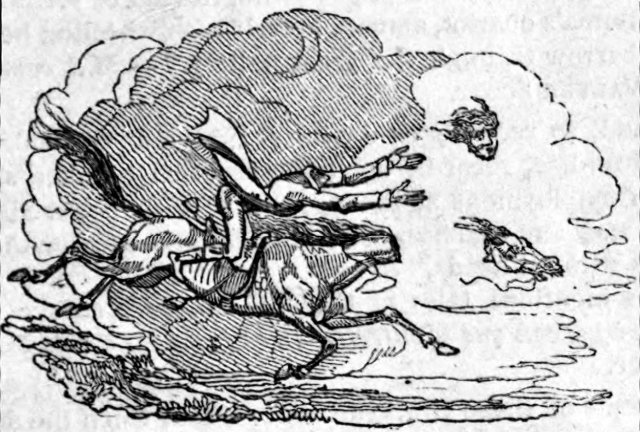
Long before «The Legend of Sleepy Hollow »Ireland had its own headless horseman. The Dullahan (meaning «dark man») is a headless figure in a black robe, a harbinger of death who «thunders through the night» on horseback, using a human spine as a whip. Alternatively, he might ride in his enormous black carriage— «coach-a-bauer» , which was pulled so incredibly fast by six headless horses that it would set the side of the road on fire.
Traditionally, the Dullahan is the embodiment of paganism god of fertility Crom Dabha , whose bloody sacrificial rite included decapitation. He holds the head close to his hand, despite its resemblance to a piece of moldy cheese. Raising it, the Dullahan can see for miles the surrounding area in his midnight pursuit of the dying. It also serves as a lantern—its decaying phosphorescence is sufficient for his vision.
All gates are open to the Dullahan, locked or not. So resistance is futile. You don't want to get too impatient, though. Folk tales abound of those who gaze from their windows for a glimpse of the Dullahan, only to have their eyes bleed.